CNC Cutting — Why the Process Determines the Product
A decorative screen is the cut pattern. The pattern is only as good as the precision with which it’s cut into the material, and different cutting processes produce genuinely different results.
Plasma cutting leaves a visible heat-affected zone around each cut edge — a slight discoloration and sometimes a roughness that requires grinding before finishing. It’s acceptable on simple shapes but becomes a problem on fine detail work where the affected zone is proportionally large relative to the feature being cut.
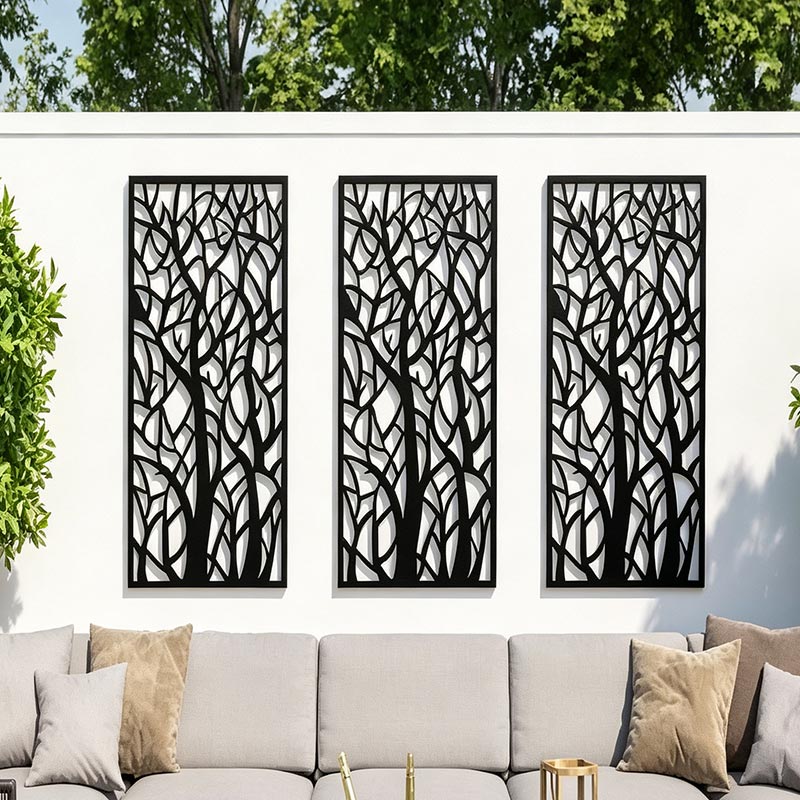
Waterjet cutting is cleaner but introduces a slight taper on the cut face — the jet diverges slightly as it exits the material, so the top face of the cut is fractionally wider than the bottom. On thick material the taper is visible. On a botanical panel with fine branch detail, the taper affects how the pattern reads from different viewing angles.
CNC laser cutting on aluminum sheet produces a different quality of edge. The laser beam width at the cutting point is measured in fractions of a millimeter. On a panel with fine botanical detail — branches, leaf veins, tight internal radii — the laser maintains consistent edge quality around every curve and at every internal corner. The cut face is clean and true. The pattern reads exactly as designed, at any scale, from a small interior panel to a large garden wall feature.
Because no physical tooling contacts the material, there is no tooling cost for custom designs and no minimum order quantity premium for bespoke work. A one-off panel with a client-specific motif costs the same per square meter to cut as a repeat catalog order.
Aluminum vs Mild Steel — The Cut-Edge Difference
Most decorative screens on the market are mild steel. Steel is cheaper to buy and easy to cut. The performance gap doesn’t show up at purchase; it shows up between year two and year five, which is why a lot of buyers don’t connect the choice they made at installation to the problem they’re looking at now.
Laser-cut mild steel has bare metal exposed at every cut edge. The laser removes the surface coating — mill scale, galvanizing, whatever protective layer was present — at the cut line. Powder coating over bare steel cut edges is not fully effective because the coating can’t wrap into the tight internal radii of a detailed pattern. A coating that ends at the edge rather than wrapping around it leaves a pathway for moisture to reach the bare metal.
Rust propagation from steel cut edges is slow at first. Year one looks fine. Year two there’s a faint rust shadow around some of the finer detail. By year three or four it’s visible from a normal viewing distance and spreading. The only remediation is abrasive stripping back to bare metal, priming, and recoating — which on a detailed cut pattern with tight internal geometry is labor-intensive and impractical to do properly.
Aluminum doesn’t have a cut-edge rust problem because aluminum doesn’t have a steel rust problem. The 6063-T5 alloy oxidizes on contact with air — that’s the oxide layer, and it forms immediately at freshly cut surfaces. It’s not a coating applied afterward; it’s a material property. A scratched or chipped aluminum panel doesn’t develop rust propagation from the damage point. The repair is cosmetic only — a touch-up powder coat pen in the specified RAL color — not a structural remediation.
For a garden wall or balcony screen that’s going to be there for a decade or longer, that material-level difference in cut-edge behavior is the reason the total cost of ownership calculation comes out differently between steel and aluminum, even when the aluminum panel costs more at the point of purchase.
Technical Specifications
Technical Item
|
Specifications & Details
|
| Product Type |
CNC Laser-Cut Aluminum Decorative Screen Panel |
| Material |
6063-T5 Aluminum Alloy flat sheet |
| Sheet Thickness |
1.5 mm (interior / light duty) to 6.0 mm (structural / high-traffic outdoor) |
| Cutting Method |
CNC laser cutting — consistent edge quality, no tooling cost for custom designs |
| Pattern Options |
Standard catalog: botanical, geometric, Islamic, art-deco, contemporary abstract. Custom: any vector design (AI / DXF / SVG format accepted) |
| Surface Finish |
Chromate primer + powder topcoat — matte, satin, gloss, or metallic; standard or custom RAL colors |
| Panel Width |
Fully customizable — no standard width constraint; specify per project |
| Panel Height |
Fully customizable — no standard height constraint; specify per project |
| Fixing Options |
Wall-mount with concealed Z-clips, visible countersunk screws, welded standoff posts, or frame-mounted (supplied or customer-provided frame) |
| UV & Weather Resistance |
Powder coat rated 15+ years color and adhesion stability under direct UV, rain, and salt-air exposure |
| Indoor Application |
Feature walls, room dividers, ceiling baffles, retail fit-out, hospitality interiors, staircase cladding |
| Outdoor Application |
Garden feature walls, balcony privacy screens, pergola infill panels, gate infill, entrance canopy fascias, pool area screening |
| Lead Time |
Standard catalog patterns: 10–15 working days. Custom designs: 15–20 working days from artwork approval |
| Customization |
Panel size, sheet thickness, pattern design, RAL color, finish type, fixing method, framing option |
Installation and Aftercare
The panel arrives cut, coated, and ready to fix. There’s no site finishing, no cutting, no touch-up coating required after installation.
For wall-mounting on masonry or concrete: the standard method uses concealed Z-clip brackets. The wall-side clip anchors to the backing with expansion bolts; the panel-side clip bonds or screws to the back face of the panel. The two clips engage with a downward slide — the panel holds flat against the wall with no visible fixings on the front face. Panels can be removed and repositioned without damaging the wall surface, which is relevant for interior installations where a tenant or owner may want to move a feature panel later.
For freestanding applications — garden dividers, pergola infill panels, entrance screens — the panel sits in a matching aluminum channel frame, and the frame posts fix to the ground or structure. JHR supplies matching frame profiles in the same powder-coat finish as the panel on request.
Aftercare is cleaning. Periodic wipe-down with water and a soft cloth removes atmospheric deposit buildup, which on a detailed botanical pattern with tight internal geometry tends to collect in the recesses. No retreatment, no repainting, no specialist maintenance.
If the panel gets scratched — contact during installation, something dragged across it later — the repair is a touch-up powder coat pen in the specified RAL color. The scratch doesn’t propagate into rust. It stays as a surface cosmetic issue until it’s convenient to address.
Panel dimensions, sheet thickness, pattern preference (catalog reference or artwork file), and RAL color are enough to start a quote. One working day for specification sheet and pricing.