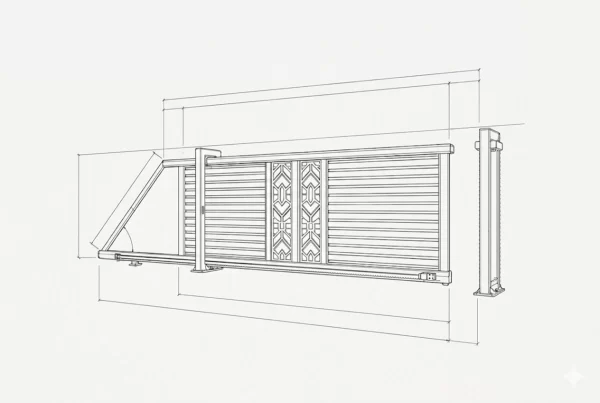
Rust-free construction — permanently
6063-T5 alloy doesn’t need periodic rust treatment to stay structurally sound. The oxide layer is part of the metal’s chemistry, not a coating. In practice, that means no repainting schedule, no remediation at the hinge seats or bottom rail, no watching the surface treatment fail in stages over a few coastal seasons.
Leaf widths from 2.0 m to 8.0 m
Standard production covers most residential and light commercial openings. For entrances where total span exceeds 8.0 m per side, the engineering team works from specific site dimensions.
Three-point stainless steel hinges per leaf
The load from a swinging leaf isn’t evenly distributed — the bottom hinge takes the most when the gate is open at full extension. Three-point mounting spreads that across the post more evenly, which is why the geometry holds over years of daily use rather than the gate developing a gradual droop on the latch side.
Flat-pack shipping
Each leaf packs flat against a foam-lined board and loads at standard pallet density. No protruding brackets, no custom crating. Relevant for international orders where steel gates with irregular profiles create freight complications.
Motor compatible — all major swing gate systems
Articulated arm, underground, and hydraulic operators at 24V DC or 220V AC. Soft-start and soft-stop are standard on compatible motor units. The gate frame doesn’t require modification to accept any of these drive types.
Inward or outward swing, specified at order
The direction is set by how the hinges are mounted. On sites where inward swing conflicts with a slope or a setback constraint, outward swing is the straightforward alternative.
Why Hinge Longevity Is the Real Specification on a Swing Gate
Nobody talks about hinges when they’re evaluating gate quotes. They look at the panel style, the color, the price. The hinges come up later — usually when the gate starts dropping on one side, or when it takes noticeably more effort to open than it used to, or when the latch no longer meets center because the leaf has drifted a few millimeters over a couple of years.
That progression is predictable on steel gates. The hinge pin sits in a socket, and every cycle puts rotational load on that interface. In steel, a thin corrosion film forms at the contact surface — almost invisible at first, but it increases friction, which increases wear, which increases the play in the joint. Meanwhile the gate is also getting heavier in relative terms as the frame accumulates surface treatment, rust inhibitor, and whatever remediation work has been done. The combination of increasing weight and increasing joint play is what produces the droop.
Aluminum handles the sequence differently. The 6063-T5 profile doesn’t corrode at the hinge seat — there’s no film forming at the interface to start the friction cycle. JHR pairs the aluminum frame with stainless steel hinge pins running in machined bearing seats; those two materials don’t react galvanically in a way that produces binding. The gate weighs 40% less than the equivalent steel version from the first day, and that weight stays consistent because the frame isn’t accumulating remediation layers. A lighter load on a hinge that isn’t corroding is a different maintenance reality than what steel swing gates deliver over a ten- or fifteen-year service life.
The surface finish follows the same logic: AkzoNobel powder coat applied to the aluminum substrate. The adhesion on aluminum is better than on steel because there’s no mill scale to trap under the coating and no rust pathway through pinhole voids. The finish doesn’t peel, doesn’t crack at the hinge seat, and doesn’t require the touch-up cycle that keeps painted steel gates looking acceptable rather than good.
Style Options
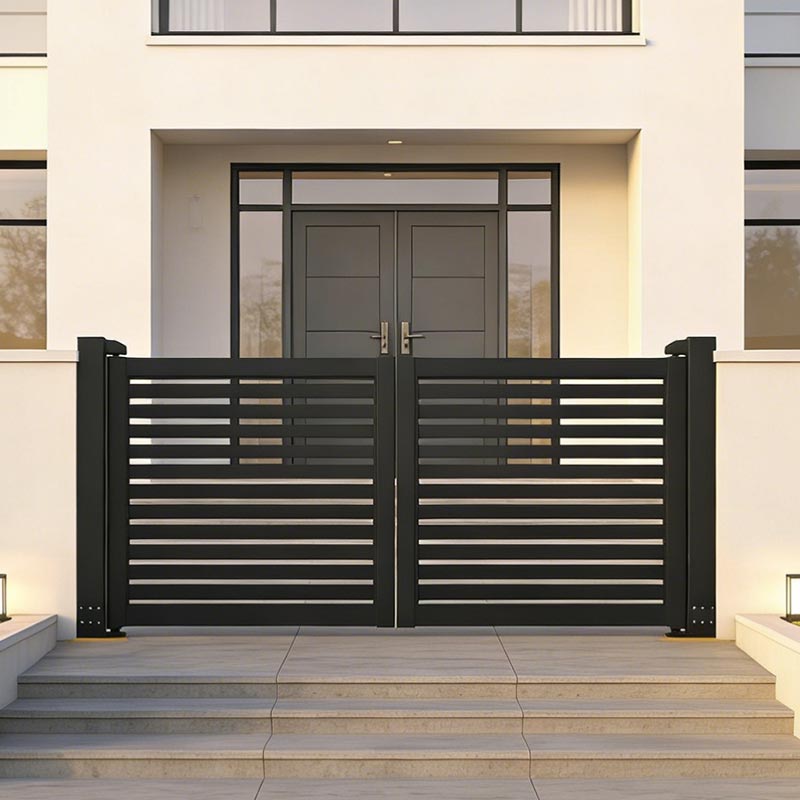
Louvered horizontal slats
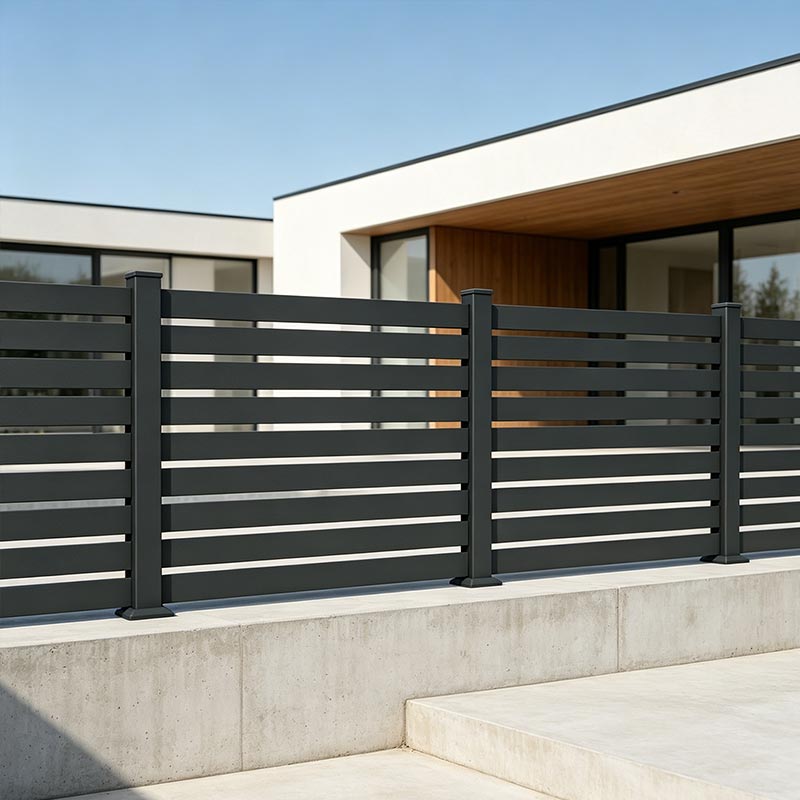
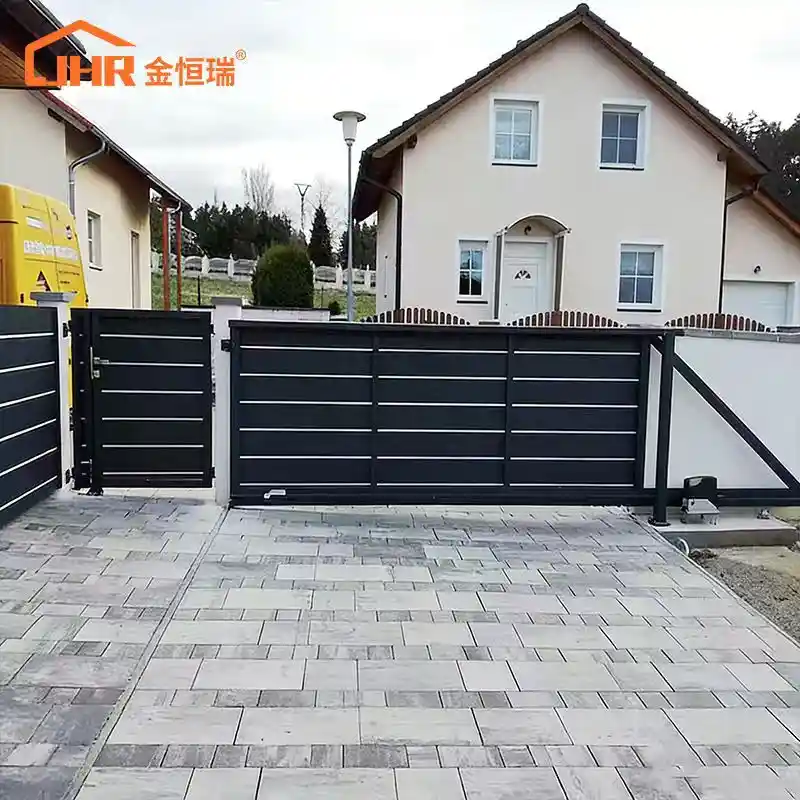
Louvered horizontal slats are what most people end up with, and there’s a straightforward reason: the angled slat blocks direct eye-level sightlines without making the gate look solid. At street level, a visitor can’t see through clearly; from above or at an angle, there’s airflow and a sense of openness. It reads well against flat-facade contemporary architecture without the visual weight of a full privacy board.
Vertical pickets
Vertical pickets work where the gate is meant to announce a boundary rather than screen behind it. Traditional residential styles, heritage properties, sites where the perimeter fence is already vertical in character. Picket spacing adjusts within the frame dimensions — tighter for more visual separation, open for a lighter feel.
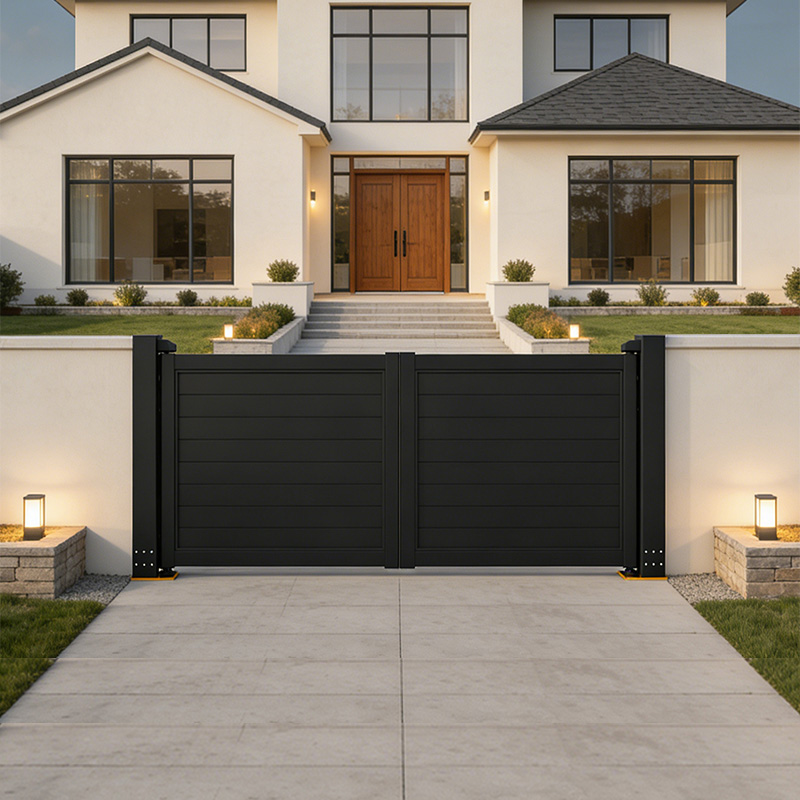
Full privacy board
Full privacy board is the option for sites where the partial sightline isn’t good enough. Road-fronting properties, commercial entrances where what’s inside is simply not the public’s business, residential driveways where the owner decided they don’t want the ambiguity of slat spacing. No gaps. The choice is usually driven by the site situation rather than aesthetics.
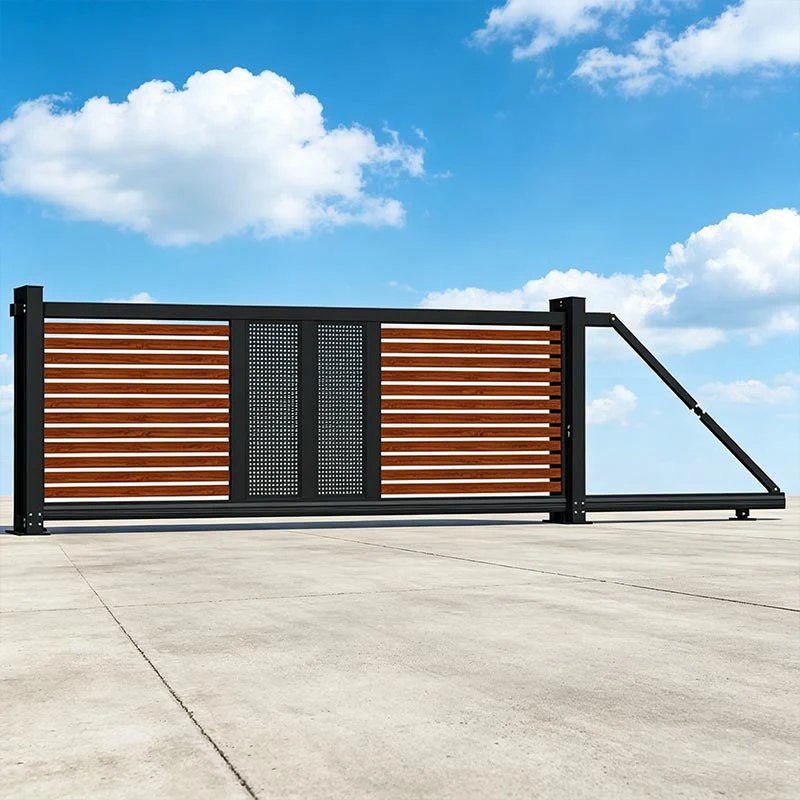
Laser-cut decorative panels
Laser-cut decorative panels are for entrances that are meant to be looked at. CNC-cut from flat aluminum sheet, fitted into the standard frame — geometric patterns, botanical motifs, property-specific shapes. The weight addition is minimal because it’s still aluminum sheet; the visual impact is disproportionately large on the right property. These are specified when the gate is part of a broader entrance design statement rather than just an access control mechanism.All infill types available in any RAL color. Custom matching to an existing fence line, wall, or architectural palette is standard — not an upsell.
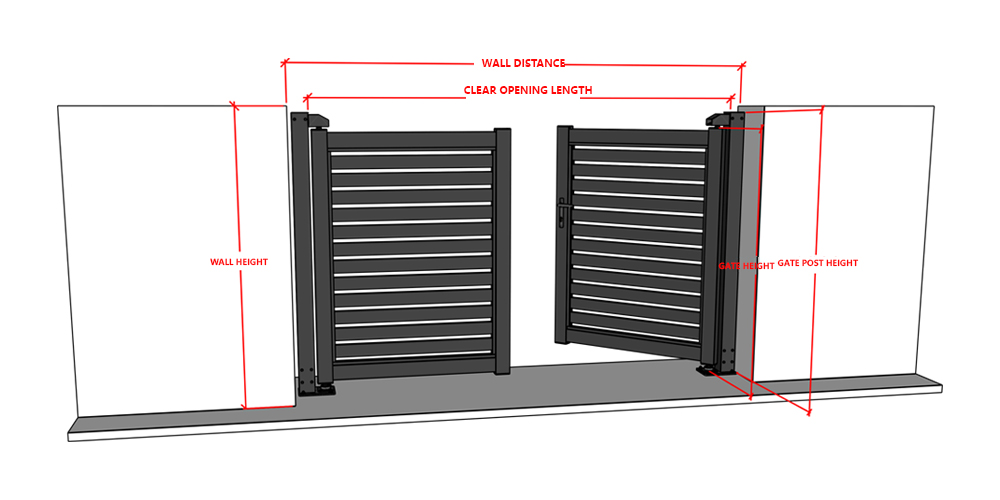
Double swing gate
Product Specifications
Technical Item
|
Specifications & Details
|
| Gate Structure |
Double leaf swing gate (opens inward or outward) |
| Material |
6063-T5 Aluminum Alloy extruded profiles |
| Surface Finish |
High-build powder coating — standard or custom RAL colors (AkzoNobel) |
| Gate Width |
2.0 m to 8.0 m per leaf (total opening up to 16.0 m; customizable) |
| Gate Height |
0.9 m to 2.4 m (customizable to project requirement) |
| Hinge System |
3-point stainless steel heavy-duty hinges per leaf; adjustable for post alignment |
| Post Requirement |
Square or round aluminum or steel posts; supplied or customer-provided |
| Automation |
Compatible with articulated arm, underground, or hydraulic swing gate operators (24V DC / 220V AC) |
| Safety Features |
Infrared photocell sensors, auto-reverse on obstacle, manual release, optional keypad / intercom integration |
| Panel Infill Options |
Louvered horizontal slats, vertical pickets, full privacy board, laser-cut decorative panel |
| Shipping Format |
Flat-pack export cartons — compatible with standard pallet and container loading |
| Application |
Residential driveways, villa entrances, garden courtyards, gated communities, commercial perimeter access |
| Customization |
Leaf width, height, infill style, RAL color, hinge count, inward or outward swing, automation package, matching pedestrian gate |
Installation and Shipping
Two posts in concrete footings, set far enough apart for the opening and deep enough to carry the lateral load from the swinging leaves — that’s the structural foundation of a double swing gate installation. JHR supplies pre-drilled hinge plates and a full fastener kit with each order. The hinges arrive pre-fitted to the gate frame, so on-site work comes down to mounting to the posts and running final alignment before the motor goes on.
The swing arc is the site constraint to check before installation. Inward swing needs clear space behind the opening — a driveway that slopes away, a courtyard with room to receive the leaves. Outward swing resolves that constraint but introduces a clearance zone in front of the gate that a parked car or a setback boundary can complicate. That decision gets made at the quoting stage, not during installation.
Shipping holds up on international orders because the format is flat. Each leaf lies against a foam-lined baseboard, cartons stack at standard pallet density, container loading is straightforward. Steel gates of similar dimensions ship irregularly because of hinge arms and weld profiles that don’t pack flat — the crating is heavier, the freight volume is higher, and transit damage shows up more often. Aluminum flat-pack doesn’t have those problems. For project-volume orders across multiple units, the logistics difference accumulates into a meaningful cost gap.
Technical drawings in PDF format ship with every order. Post sizing, footing depth, and motor selection support from the engineering team are available for any specific site condition — no additional charge.
Opening width, leaf height, preferred infill style, swing direction, and site location are enough to start a quote. One working day for specification sheet and pricing. Contact options are on the product page.