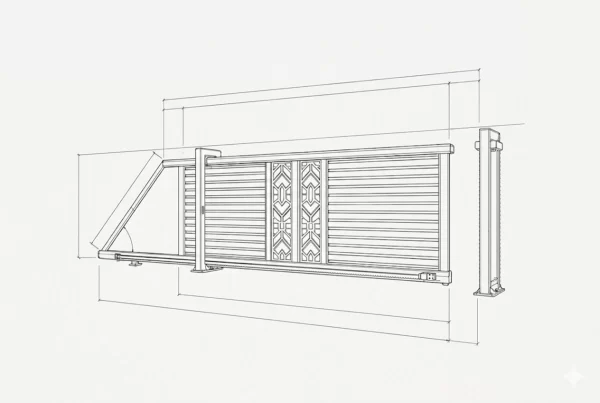
Best-seller for a reason
Thousands of residential and commercial installations across different climates and site types. The tracked slider wins on volume because it’s the least fussy gate type to install, commission, and maintain over time.
Side clearance, not swing arc
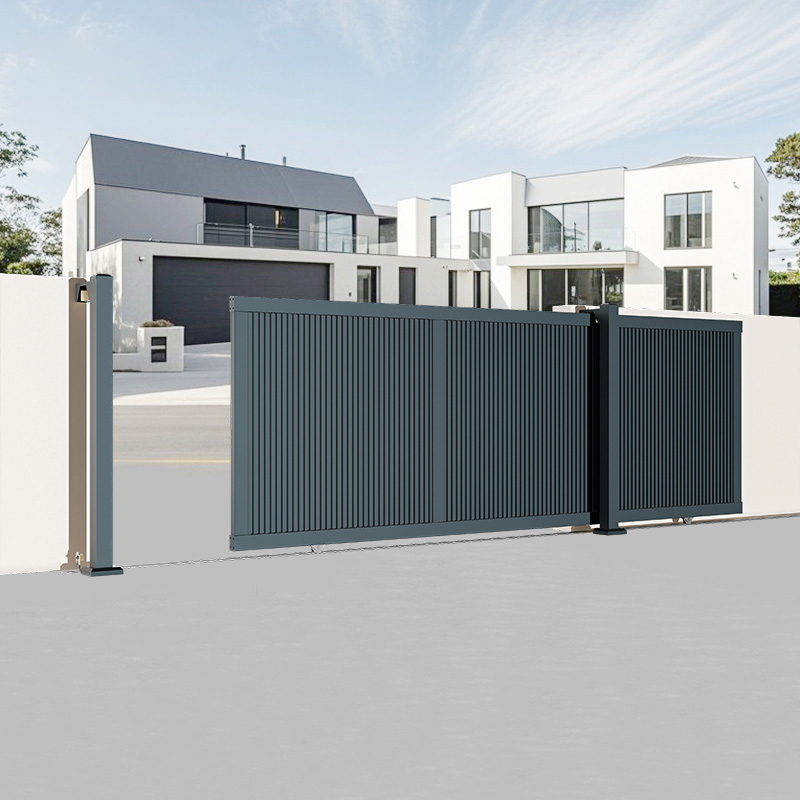
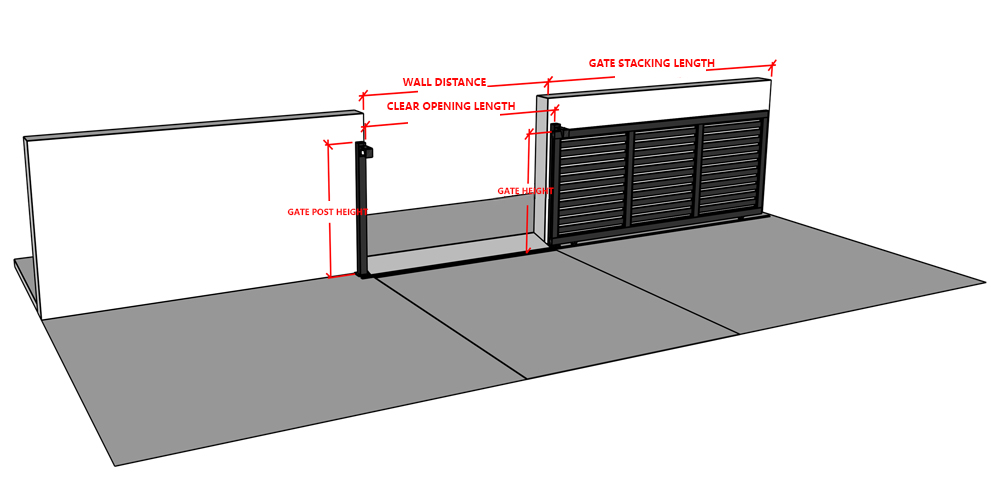
The gate retracts parallel to the wall. No swing zone in front of the opening, no overhead structure, no radius to keep clear of parked cars or planting. The side clearance needed equals roughly the gate width — on most sites, that’s straightforward to find.
Width range: 2.0 m to 12.0 m
Standard production covers most residential and light commercial openings. Configurations outside that range are handled as custom orders with the same lead time.
Double-roller track system
Two rollers per carriage, load distributed evenly. The gate doesn’t sag on one side, doesn’t drift laterally, and doesn’t put uneven wear on the track surface. After a few years of daily use, that consistency is what keeps a tracked gate running straight without constant fiddling.
Panel options
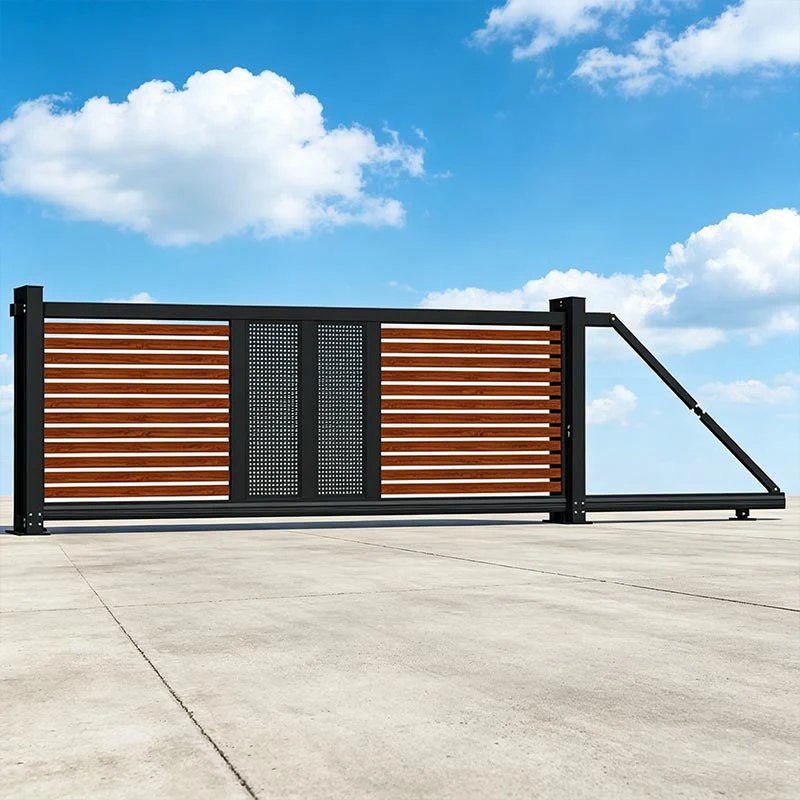
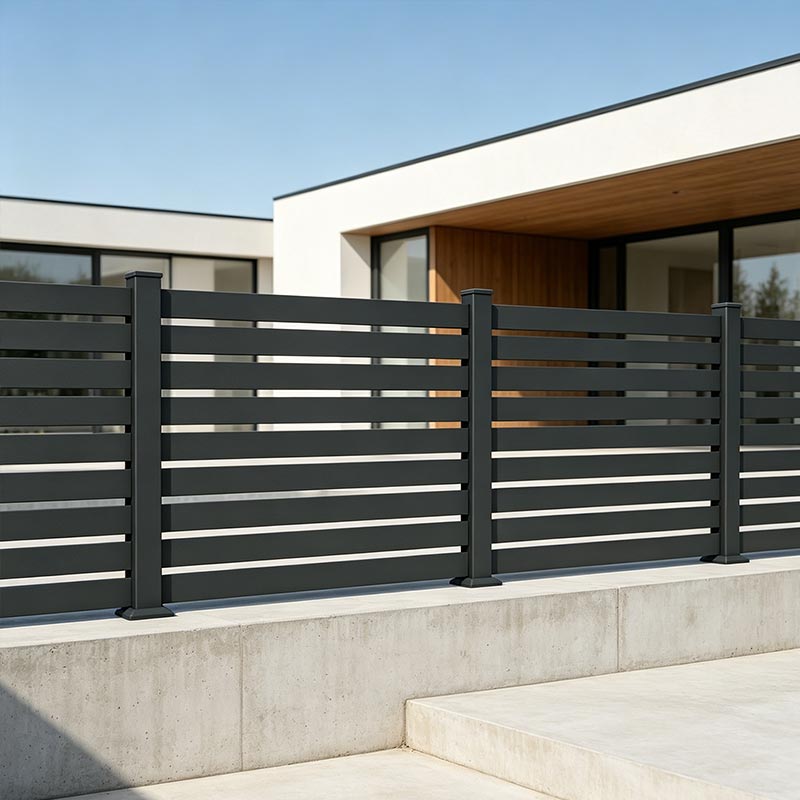
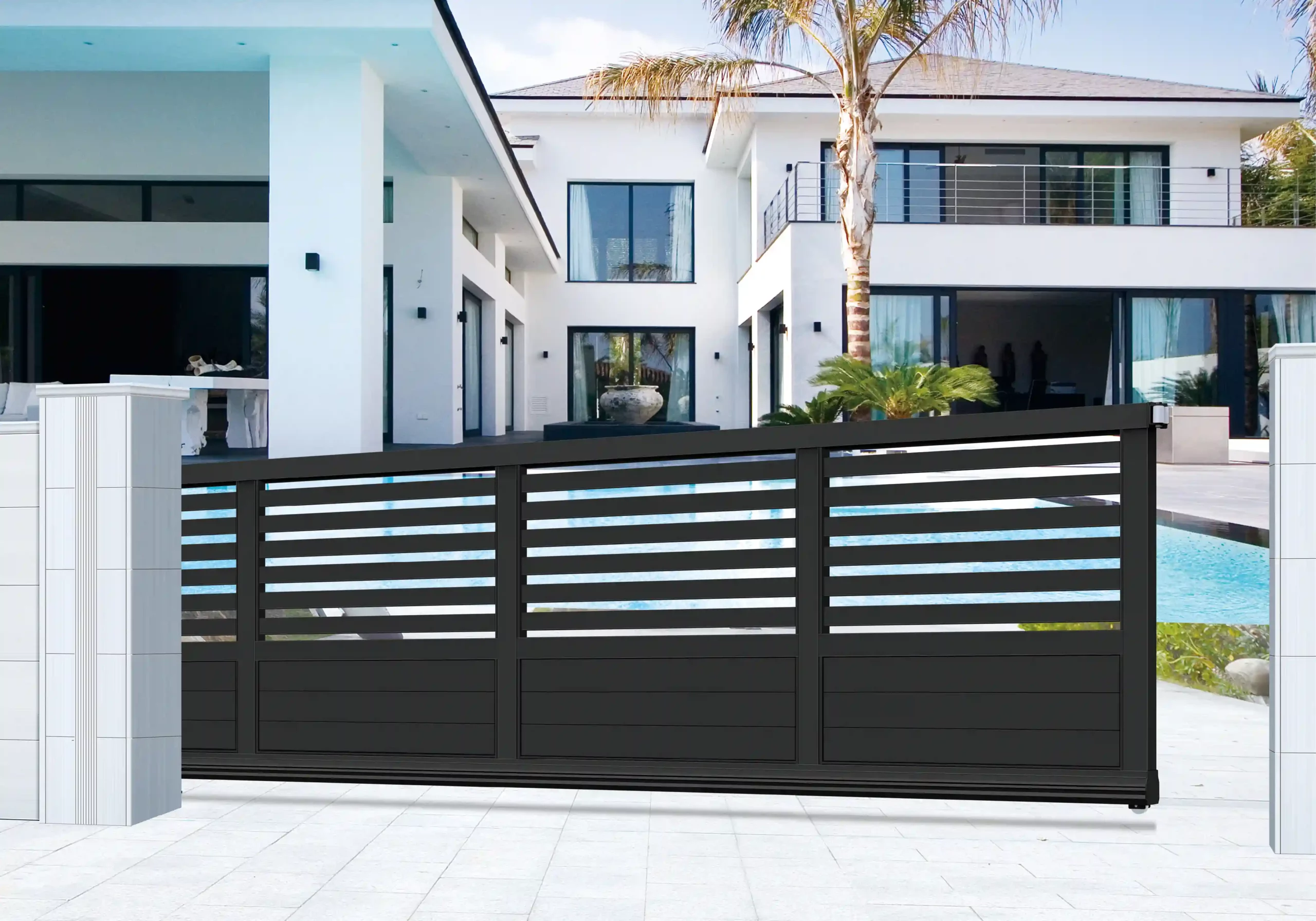
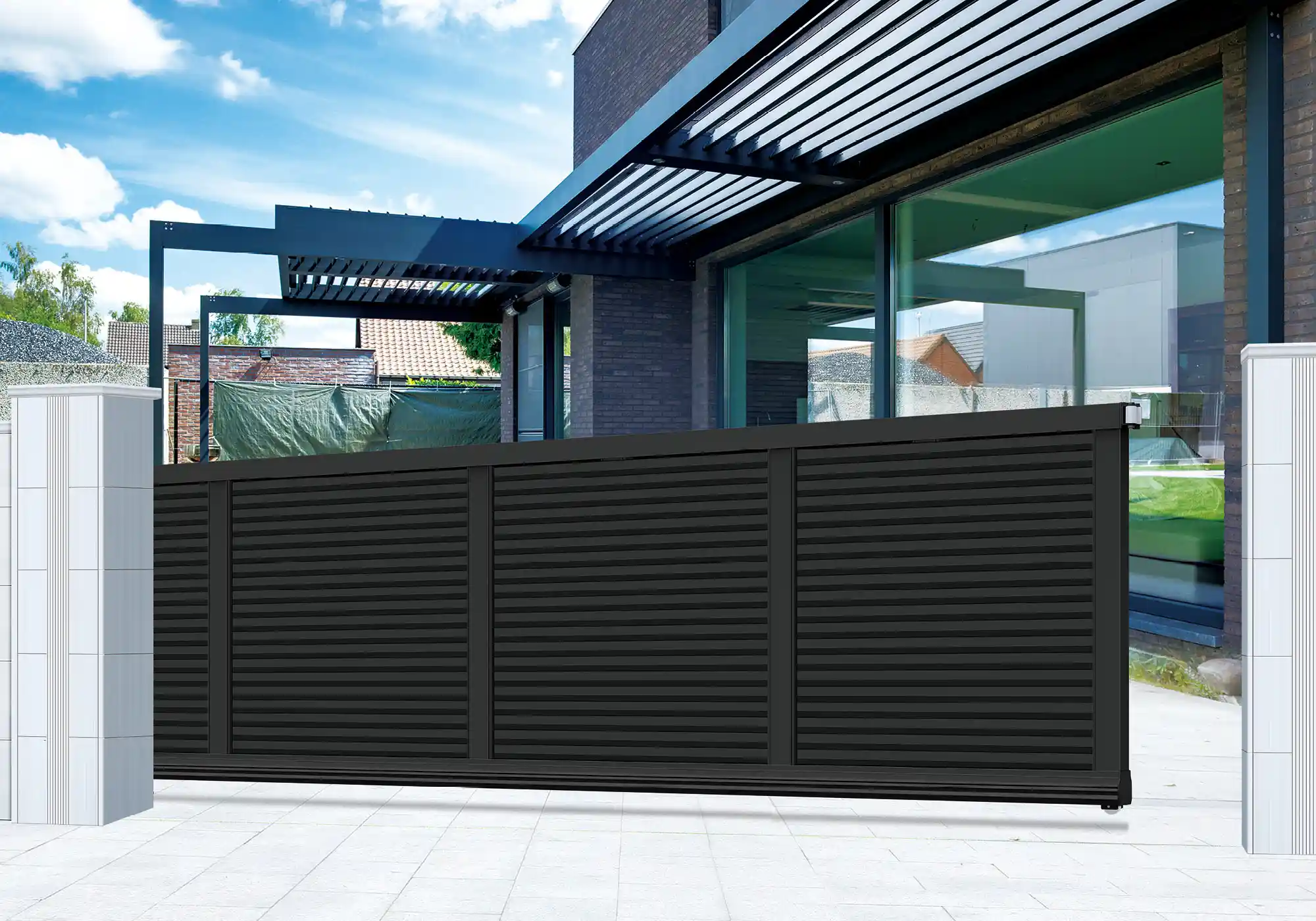
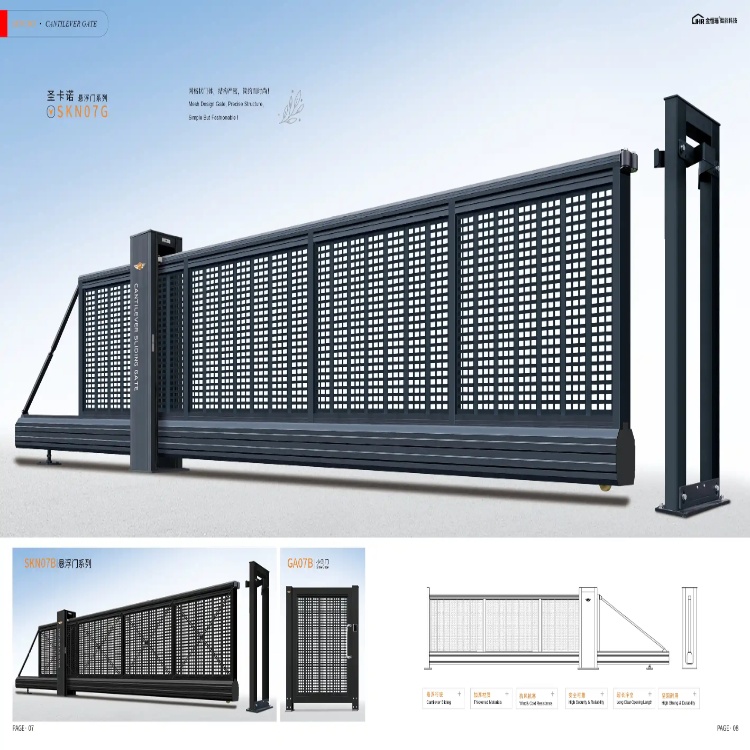
Horizontal slats, vertical pickets, privacy board, laser-cut decorative panel. Same frame, different face — specified at order.
Motor and safety hardware
Compatible with all major 24V and 220V sliding gate operators. Infrared photocells, auto-reverse, and manual release all connect without modification to the gate frame.
The Steel vs. Aluminum Conversation on a Tracked Gate
Steel comes up in tracked gate conversations because the upfront cost is sometimes lower. The relevant question is what happens at the contact points — specifically, where the roller bearings meet the gate frame and where the bottom rail sits against the ground track.
Those are the spots where water sits. In a steel gate, that’s where the corrosion starts: inside the roller housing, along the underside of the bottom rail, at any weld line that wasn’t coated evenly during fabrication. The rust doesn’t announce itself early — you get a season or two of normal operation, then the rollers start binding, the gate drags on the track, and eventually the drive motor is pulling against friction it wasn’t sized to handle.
Aluminum sidesteps the problem at the material level. The 6063-T5 alloy forms its own oxide layer — that’s not a coating, it’s a metallurgical property — and it re-forms if the surface gets scratched. The powder coat on top is there for color. It’s not doing the corrosion-resistance work; the metal itself handles that. On a coastal installation or anywhere with ground-level moisture, the difference in long-term track condition between a steel gate and an aluminum gate on the same site is usually visible within three to five years.
Weight is the other thing. At 40% lighter than steel, the aluminum frame puts less force on the track at rest and generates less inertia on each open-close cycle. The motor operates within a more comfortable margin of its rated capacity, which extends the drive unit’s service life. Smaller rollers can carry the load. The overall system wears at a slower rate — not dramatically, but measurably over a decade of use.
Style Options
The frame is consistent across the product range. What changes is the panel infill, and that decision is mostly driven by the visual context and the privacy requirement of the site.
Horizontal slats are the most common specification on contemporary residential projects. The horizontal line reads well against flat-facade architecture, and the slat spacing can be tightened or opened depending on how much visual separation from the road the owner wants.
Vertical pickets suit properties where the gate reads as a boundary marker first and a design element second — traditional residential styles, heritage-adjacent settings, or sites where the surrounding fence line is already vertical in character.
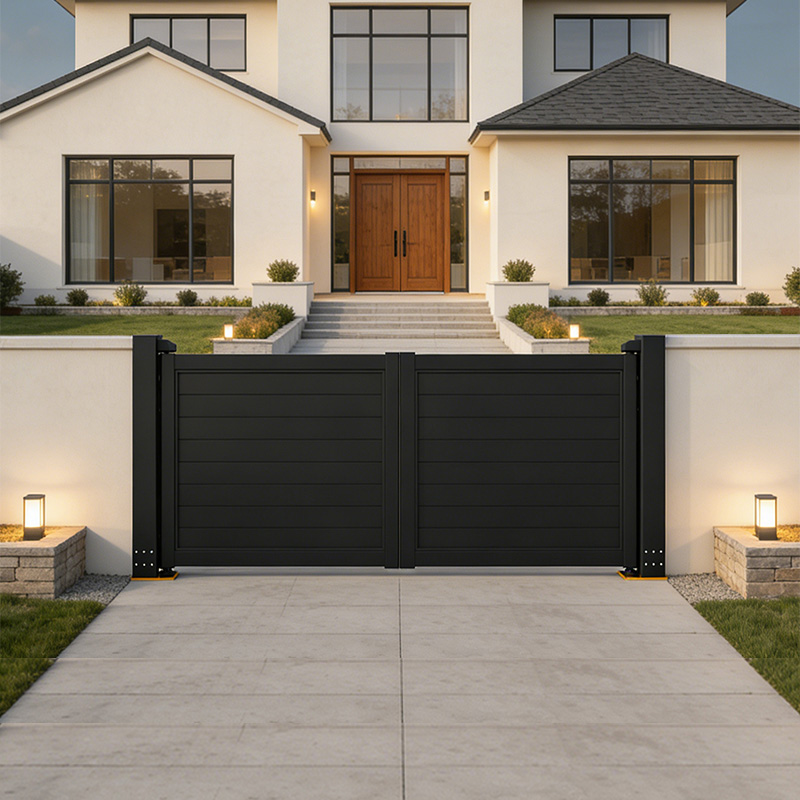
Full privacy board is the practical choice when the property directly fronts a public road or a shared access lane. There are no gaps, no partial sightlines, and no conversation to have with the owner about whether the slat spacing is close enough.
Laser-cut decorative panels are specified when the entrance is meant to be noticed — custom geometric or organic cut patterns that pick up a motif from the architecture or the surrounding landscaping. The cut patterns don’t add meaningful weight to the panel.RAL color matching runs across all infill types. If there’s an existing fence, wall, or cladding color on site, that’s the starting point; custom RAL is standard, not an upgrade.
sliding gate
Product Specifications
Technical Item
|
Specifications & Details
|
| Gate Structure |
Single-leaf or bi-parting tracked sliding gate |
| Material |
6063-T5 Aluminum Alloy profiles |
| Surface Finish |
Powder coating — standard or custom RAL colors |
| Gate Width |
2.0 m to 12.0 m (customizable to project requirement) |
| Gate Height |
0.8 m to 2.5 m (customizable) |
| Track System |
Ground-level steel track with dual heavy-duty rollers |
| Roller Type |
Double nylon-coated or steel rollers with grease-sealed bearings |
| Automation |
Compatible with all major 24V / 220V sliding gate motor brands |
| Safety Features |
Infrared photocell sensors, auto-reverse on obstacle, manual release |
| Panel Infill Options |
Horizontal slats, vertical pickets, privacy board, laser-cut decorative panel |
| Application |
Residential driveways, villas, gated communities, commercial entrances, industrial access |
| Customization |
Width, height, infill style, RAL color, automation package, matching pedestrian gate |
Installation and Site Requirements
The tracked slider is the gate type that installation teams take on without a site visit first. The requirements are defined: a level ground track, a guide post at the end of the travel path to keep the panel upright, and a fixed mounting point for the motor adjacent to the opening. No foundation geometry to calculate, no overhead structure to align. Contractors who’ve done one do the next without the drawings.
JHR supplies a complete hardware kit and PDF installation drawings with every order. For contractors handling multiple units on a development project, the technical team is available for layout planning and motor sizing support at no extra charge — the aim is to avoid the kind of site problem that generates a support call two weeks after commissioning.
Gate width, height, infill style, and site location are enough to start a quote. The team turns around a specification sheet and pricing within one working day. Contact options are on the product page.