304 stainless steel — corrosion resistance that doesn’t require intervention
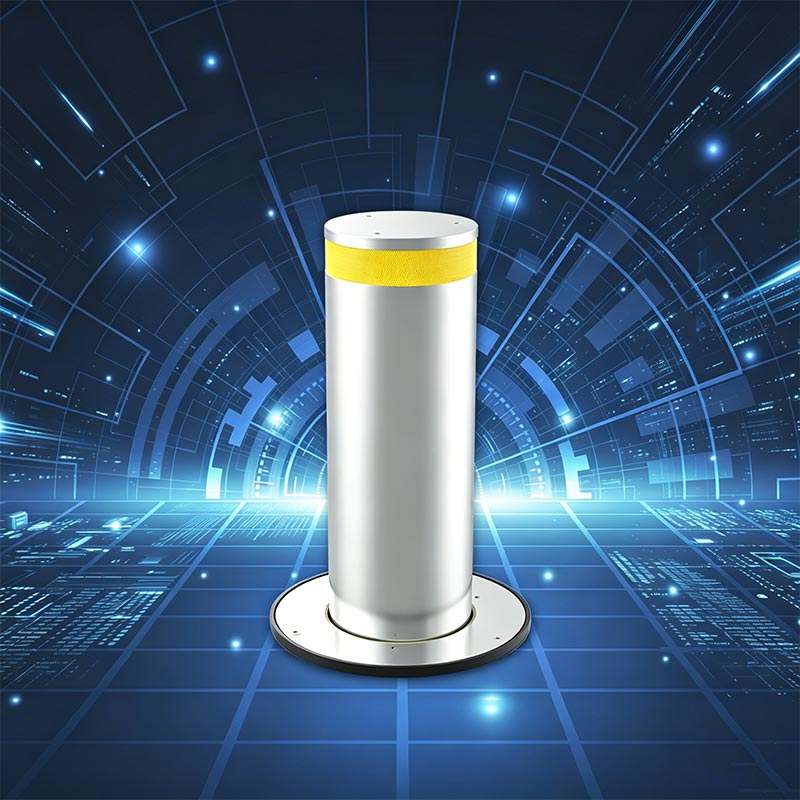
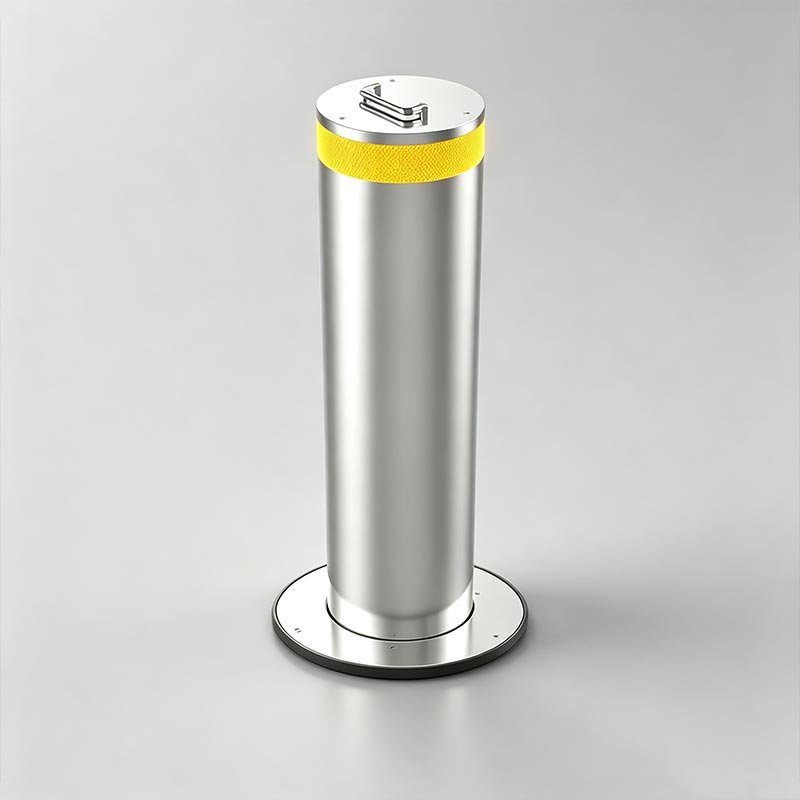
The chromium content in 304 stainless (minimum 18%) produces a chromium oxide layer on the steel surface that re-forms when damaged. At a scratch or nick, the layer reforms on contact with oxygen — the bollard doesn’t need to be recoated for that repair to happen. No painting schedule, no rust treatment, no surface retreatment. In a security application where a bollard going offline for maintenance creates a gap in the perimeter, that maintenance-free characteristic has direct security value, not just cost value.
Rise and retract under 4 seconds
Hydraulic drive achieves the 4-second cycle in both directions. Electro-mechanical (linear actuator) runs slightly slower — under 6 seconds — which is still within the throughput requirement for most controlled entry points. The cycle time setting is configurable within the controller; slower cycles are available where the site situation calls for a more cautious rise.
Custom diameter and height
Standard diameters: 168 mm, 219 mm, 273 mm. Above-ground height: 500 mm to 900 mm. The diameter and wall thickness specification determines the impact resistance class. JHR specifies the correct combination at the quotation stage based on the site’s threat assessment and any applicable EN or IWA standard requirement.
Fail-safe modes — raised or lowered
The controller fail-safe mode is set at commissioning. Fail-safe raised means a power failure holds the bollard up — the secure default for most security applications. Fail-safe lowered is available for emergency vehicle access routes where a power failure must not block vehicle passage. The choice depends on the site’s priority: security continuity or access continuity.
Battery backup option
For sites where power reliability is uncertain or where a power failure during an access-controlled event would create a security gap, battery backup units are available. Worth specifying at the order stage.
Minimal civil works
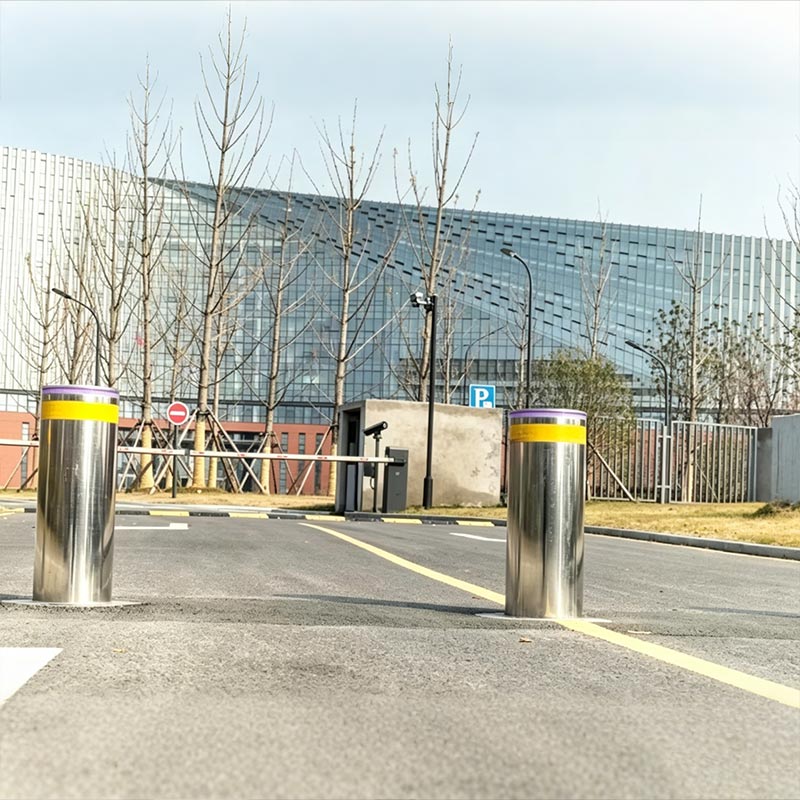
Installation goes into a pre-cast concrete housing set into a cored or formed opening in the pavement. No overhead structure, no surface track. When retracted, the flange is flush with the road surface. The civil works scope is a single core hole per bollard, which is far less disruptive than installing a gate system across the full width of an entry lane.
Why 304 Stainless Steel for a Security Bollard
The bollard’s operating environment is specific: it sits outdoors, partially or fully embedded in pavement, in direct contact with rainfall, road runoff, tyre rubber, de-icing salt in winter, and vehicle exhaust continuously. The material it’s made from either handles that environment independently or requires periodic maintenance to keep it functional. On a security element where going offline for retreatment is the same as removing the barrier, the maintenance requirement is a security variable, not just a maintenance cost.
Mild steel bollards exist. They’re cheaper at purchase. The performance gap becomes relevant in year two or three. Mild steel corrodes from any damage point — a scratch, a nick from a tyre contact, a spot of weld heat that burned through the galvanizing — outward under the surface coating, lifting the paint in a ring around the damage before the corrosion is visible. By the time it’s visible it’s structural, not cosmetic. On a bollard that absorbs daily vehicle approach and contact from passing traffic, surface damage is not an occasional event.
304 stainless doesn’t have that failure mode. The chromium oxide layer re-forms at the damage site on contact with oxygen. A scratch stays a scratch — it doesn’t propagate. The visual finish — mirror polish or brushed satin — requires periodic cleaning to maintain its appearance, but the structural integrity of the bollard is unaffected by surface contact.
The material hardness also contributes to impact performance. 304 stainless steel has higher tensile and yield strength than mild steel at the same wall thickness. A bollard rated to a given impact class can achieve that rating with a thinner wall section in stainless than in mild steel — which reduces the bollard weight, makes the housing installation more practical, and keeps the in-ground footprint manageable in pavement sections that have limited depth below the surface.
For coastal or high-chloride sites — port facilities, beachside hotels, seaside shopping precincts — 304 is the standard commercial-grade stainless. If the chloride exposure is continuous and concentrated, 316-grade stainless provides additional resistance. JHR advises on the appropriate grade at quotation based on the site location and exposure description.
Access Control — Matching the Method to the Site
A bollard that is slow to operate gets propped down. That’s the real operational risk, and it’s been observed at enough security installations that it should inform how the access method is specified from the start.
The access method determines whether the bollard functions as a security barrier or as a time-consuming inconvenience that operators work around. For a site with two or three known vehicle operators, an RF remote is the correct specification: press the button from inside the vehicle, the bollard drops, the vehicle passes, the bollard rises on a timer. No stopping, no card, no code. Total added time in the vehicle journey: under 10 seconds.
For sites with a larger population of users, different clearance levels, or a requirement to log individual access events, the credential-based options:
PIN keypad: Post-mounted adjacent to the approach lane. Individual codes per user, temporary codes for contractors or service visits with automatic expiry dates. Access log stored in the controller. The main vulnerability of PIN is code sharing — one user gives their code to another. For sites where that’s a real concern, biometric or card-based access provides better individual accountability.
Fingerprint reader: Outdoor-rated capacitive sensor. Up to 100 enrolled fingerprints; recognition under 0.5 seconds. The biometric data stays in the reader hardware, not on a network server — relevant for sites with data security requirements. Works reliably on clean hands; performance on heavily soiled hands varies by sensor generation.
RFID card and fob reader: 125 kHz EM or 13.56 MHz Mifare proximity reader. Cards and fobs issued and revoked from the administrator panel — access changes take effect immediately without visiting the bollard. Compatible with existing site access cards on most standard-frequency systems, which avoids issuing a separate credential for the bollard.
Smartphone app: Bluetooth proximity unlock for walking personnel; GSM module for remote authorization from any location, real-time status monitoring, and access log in the app. The GSM option is the one that allows a site manager to authorize a visitor remotely without being on site.
BMS integration: Dry contact relay and RS485 interface connect the bollard to building-wide access scheduling, CCTV triggering, and alarm systems. For multi-bollard installations — up to 8 units on a single controller panel — this is the integration point that lets the security system manage the perimeter as a whole rather than as individual units.
Product Specifications
Technical Item
|
Specifications & Details
|
| Product Type |
Automatic Security Lifter (Rising / Retractable Bollard) |
| Body Material |
304 Stainless Steel (316 grade available for coastal / high-chloride sites) |
| Surface Finish |
Mirror polished, brushed satin, or powder coated; yellow safety band and reflective strip options |
| Bollard Diameter |
168 mm / 219 mm / 273 mm (standard); custom diameters on engineering review |
| Above-Ground Height |
500 mm to 900 mm (customizable to site requirement) |
| Drive System |
Hydraulic (24V DC pump) or electro-mechanical (24V DC linear actuator) |
| Rise / Retract Cycle |
Under 4 seconds rise and retract (hydraulic); under 6 seconds (electro-mechanical) |
| Operating Modes |
Automatic rise/retract on access command; fail-safe raised (power-off = raised); fail-safe lowered option |
| Access Control Options |
RF remote (433 MHz), PIN keypad, fingerprint reader, RFID card/fob (125 kHz / 13.56 MHz), smartphone app (Bluetooth / GSM), BMS integration (dry contact / RS485) |
| Safety Features |
Obstacle detection sensor, auto-reverse on resistance, manual emergency lowering key, visual and audible warning LED/buzzer |
| Power Supply |
220V AC mains input; 24V DC internal; battery backup option for power-failure operation |
| Housing Installation |
Pre-cast concrete in-ground housing; surface flush when retracted; housing flange sealed to pavement surface |
| Traffic Warning |
Integrated LED warning light ring (amber); optional solar-powered independent LED |
| Application |
Commercial car parks, pedestrian zones, government facilities, critical infrastructure, hotel and resort drop-off, retail frontages, school perimeters, emergency vehicle access control |
| Customization |
Diameter, above-ground height, drive type, finish, safety markings, access control package, BMS interface, battery backup, housing depth |
Installation and Civil Works
The housing goes in first. It’s a pre-cast concrete unit set into a cored or formed opening in the pavement slab — the housing diameter and depth are specified based on the bollard model and drive system. JHR provides the full civil engineering specification with every order: housing dimensions, reinforcement requirements, drainage provision, and electrical conduit routing. The pavement contractor needs that specification before they core the opening, not after.
The bollard body, drive unit, and control wiring are factory-assembled and tested before shipment. On site, the housing is set and grouted into the pavement opening, the bollard assembly is lowered in and connected to the power feed and control cable, and the pavement surface is finished to the flange. The electrical connection from the mains supply to the controller box uses a standard 220V feed; cable routing to remote readers, loop detectors, or BMS connection points follows the site installation drawing.
Commissioning — rise/retract cycle testing, access credential enrollment, timer and fail-safe mode configuration — takes approximately two to four hours for a standard single-bollard installation. For multi-bollard installations in grouped or sequential configurations, the controller network manages up to eight units from a single panel. JHR provides commissioning documentation and remote technical support for all installations.
The critical civil works item to get right before anything else: the drainage provision in the housing. The bollard housing is an underground void in a pavement surface. Water gets in — from rain, from road runoff, from pressure washing of the surround. If the drainage provision isn’t correct, water accumulates in the housing, reaches the drive components, and creates the corrosion and mechanical failure that the 304 stainless body was specified to avoid. JHR’s civil specification includes the drainage detail; the installer needs to follow it precisely.
Bollard diameter, above-ground height, drive system preference, surface finish, access control package, and site location are enough to start a quote. One working day for specification and pricing.
Item
|
Recommendation
|
| H1 Tag |
Stainless Steel Automatic Security Lifter |
| H2 Tags |
Product Overview / Product Details / Why 304 Stainless Steel / Access Control / Product Specifications / Installation and Civil Works |
| Image Alt Tag |
JHR Stainless Steel Automatic Security Lifter — Rising Bollard with Smart Access for Commercial and Government Perimeter Security |
| Internal Links |
Link “security lifter” to bollard/security category page; “stainless steel” to materials overview; “RFID reader” to access control accessories; “boom barrier” to boom barrier product page; “smart access” to automation accessories |
| Schema Markup |
Add Product schema (brand, material, color, diameter range, drive type, application) for Google Rich Results eligibility |
| Content Cluster |
Blog posts: “rising bollard vs boom barrier: which is right for your vehicle access point” / “304 vs 316 stainless steel bollards: how to choose for your site exposure” / “how to integrate automatic bollards with a building management system” |