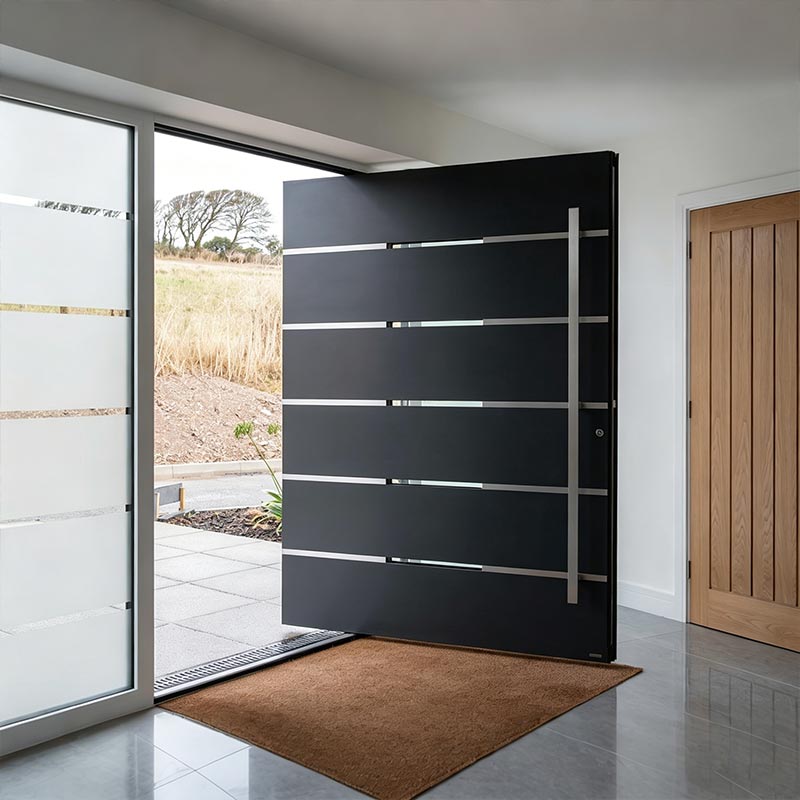
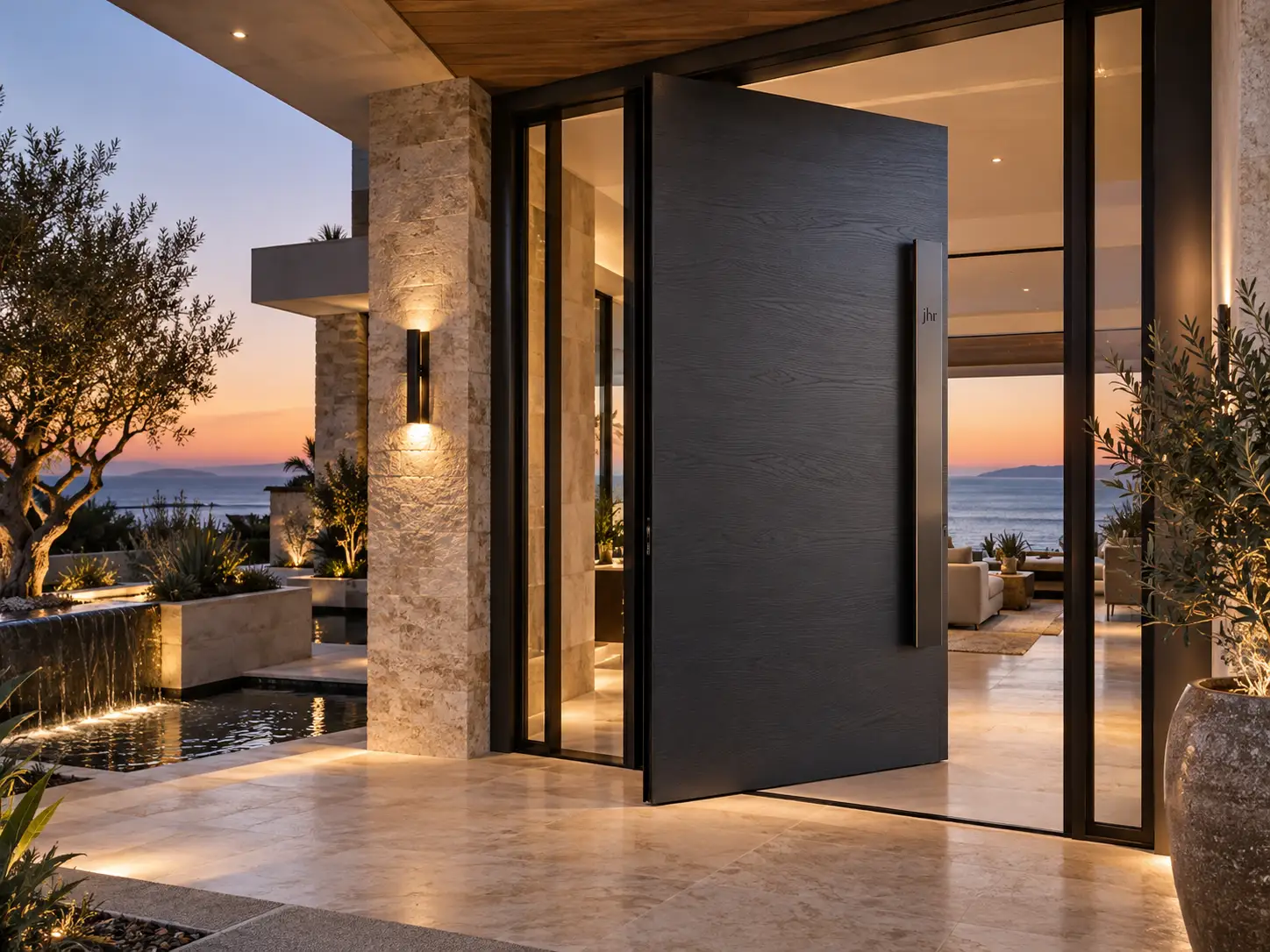
Oversized panel capability — up to 1.5 m wide, 3.5 m tall Standard production covers dimensions far outside what conventional hinge hardware can manage. For entrances where the architectural brief calls for a genuinely monumental opening, the pivot mechanism is the enabling technology that makes it practical rather than theoretical.
Thermally broken frame — up to 70% lower heat transfer Polyamide conducts heat at roughly one-thousandth the rate of aluminum. With a continuous PA66-GF25 insert between inner and outer profiles, the frame assembly doesn’t act as a thermal bridge between inside and outside the building. The interior frame face stays closer to room temperature — condensation risk drops, and the entrance wall performs better thermally as a complete assembly.
Weatherproof — multi-layer EPDM gaskets, concealed threshold drainage Outer gasket deflects wind-driven rain; inner gasket seals the air gap between panel and frame. The threshold uses a low-profile aluminum extrusion with a concealed drainage channel — water at the base of the door is managed out of sight, not pooled at the sill. The combination is rated for exposed coastal and high-wind locations.
Acoustic performance up to Rw 42 dB With double glazing and full gasket sealing. The thermally broken frame and the solid panel mass both contribute. For road-facing villa entrances and urban locations where traffic and ambient noise are constant, this is the specification that makes the difference between an entrance that seals properly and one that doesn’t.
No rust, no warping, no repainting 6063-T5 aluminum alloy doesn’t corrode, doesn’t absorb moisture, doesn’t change dimension under UV cycling. The outdoor powder coat over chromate conversion primer holds color and adhesion for fifteen-plus years without recoating. The door you install is the door you have in year fifteen.
Motorized option available A pivot operator can be integrated for hands-free or access-control-triggered opening — relevant for hotel lobbies, corporate headquarters, and residential applications where the door is used frequently enough that manual operation becomes a consideration.
The Pivot Mechanism — What It Actually Does and Why It Matters
The pivot axis is set in from the panel edge — typically at one-third of the panel width. This creates the characteristic visual behavior of a pivot door: when open, a narrow section of panel projects behind the pivot line into the interior, and the main panel face swings outward into the entrance. The geometry produces a rotation that looks and feels different from a side-hung door — more deliberate, more architectural, less domestic.
That offset also determines the balance behavior of the panel. The weight distribution on either side of the pivot axis affects how much force is needed to push the door open and how it behaves when released. The pivot hardware includes adjustable balance settings that control whether the door is free-swinging (stays where you leave it), or gravity-assisted return to closed (comes back on its own after a set angle). For residential use, gravity return is usually the preferred specification; for commercial applications where the door is propped open during business hours, free-swing is more practical.
The floor pivot requires a recessed plate set into the finished floor surface. This is the coordination item that needs to be on the construction schedule before the door is delivered — the floor finisher needs the plate dimensions and fixing pattern to prepare the recess during their phase of work, not afterward. JHR provides the coordination drawings for this at the order confirmation stage, not as an afterthought during installation.
Thermal Performance and Weatherproofing
A villa entrance door in a climate with meaningful temperature variation is a thermal boundary, not just a security barrier. The frame is where most of the thermal performance is determined — the panel itself (whether solid aluminum or glazed) can be specified for insulation, but a frame without a thermal break conducts heat directly between the exterior and interior aluminum faces regardless of what the panel does.
The JHR pivot door frame uses thermally broken construction throughout. Inner and outer profiles are manufactured as separate extrusions, assembled around a continuous glass-filled polyamide (PA66-GF25) insert. Polyamide’s thermal conductivity is approximately 1,000 times lower than aluminum — the insert doesn’t bridge the temperature difference between inside and outside, it blocks it. The practical result is an interior frame surface temperature closer to room temperature: less condensation on cold days, less heat gain in summer, better overall performance of the entrance wall assembly.
Weatherproofing uses a two-gasket system on all four panel edges. The outer gasket handles wind-driven rain; the inner gasket seals the air gap between panel and frame rebate. Together they achieve water tightness and air infiltration ratings suitable for locations that aren’t sheltered — coastal, high-altitude, and exposed urban sites. The threshold drainage channel at the base of the door handles the water that runs down the panel face and needs somewhere to go other than into the building.
Technical Item
|
Specifications & Details
|
| Product Type |
Aluminum Pivot Door — single panel or double panel configuration |
| Frame Material |
Thermally broken 6063-T5 aluminum alloy with polyamide thermal break insert |
| Frame Finish |
Chromate primer + outdoor powder topcoat — standard or custom RAL colors |
| Panel Width |
Up to 1.5 m per leaf (single panel); custom wider panels on engineering review |
| Panel Height |
2.1 m to 3.5 m (customizable to opening requirement) |
| Panel Infill Options |
Solid powder-coated aluminum, single / double / triple glazing, mixed solid-and-glazed, decorative insert panels |
| Pivot Hardware |
Top-and-bottom concealed pivot system; finish options: matte black, brushed stainless steel, satin brass |
| Thermal Break |
Continuous polyamide (PA66-GF25) insert — reduces frame heat transfer by up to 70% vs standard aluminum frame |
| Weatherproofing |
Multi-layer EPDM gasket on all four panel edges; concealed threshold drainage |
| Acoustic Performance |
Up to Rw 42 dB with double glazing and full gasket sealing (glazing specification dependent) |
| Locking System |
Multi-point locking — hook bolts top and bottom plus deadbolt at pivot height; smart lock integration available |
| UV & Weather Resistance |
Powder coat rated for 15+ years color and adhesion stability under direct UV and salt-air exposure |
| Automation Option |
Motorized pivot operator available for hands-free or access-control-triggered opening,Compatible with smart lock |
| Application |
Luxury villa entrances, hotel lobbies, corporate headquarters, showrooms, boutique retail, high-end residential developments |
| Customization |
Panel width, height, infill style, RAL color, pivot hardware finish, handle style, glazing specification, locking system, automation |
Installation and Long-Term Performance
The floor pivot plate is the item that needs to go on the construction coordination schedule before anything else. It requires a recess in the finished floor surface — dimensions and fixing pattern come from the pivot hardware specification, which JHR provides at order confirmation. If the floor finisher has already laid the surface before the plate dimensions are confirmed, retrofitting the recess is a difficult and messy task. Get the coordination drawing to the floor finisher during their phase of work.
The frame goes in after the rough opening is ready — set, leveled, anchored to the structural surround. The panel hangs on the pivot points. Pivot door installation requires an experienced team; the panel weights and alignment precision involved are higher than a conventional hinged door, and for large-format panels the balance adjustment at the pivot hardware requires someone who has done it before. JHR recommends engaging an installer with specific pivot door experience for panels above 100 kg.
Long-term maintenance is minimal. The aluminum frame and panel need no repainting. Pivot hardware uses sealed bearings — no lubrication required under normal operating conditions. Inspect the EPDM gaskets annually; if compression set is visible, replace them. It doesn’t require dismounting the door. Replacement hardware and gaskets for all standard configurations are stocked and ship within 48 hours.
Panel width, height, infill specification, RAL color, and hardware finish preference are enough to start a quote. One working day for specification sheet and pricing.