2 to 10 meters deployed per unit, one operator
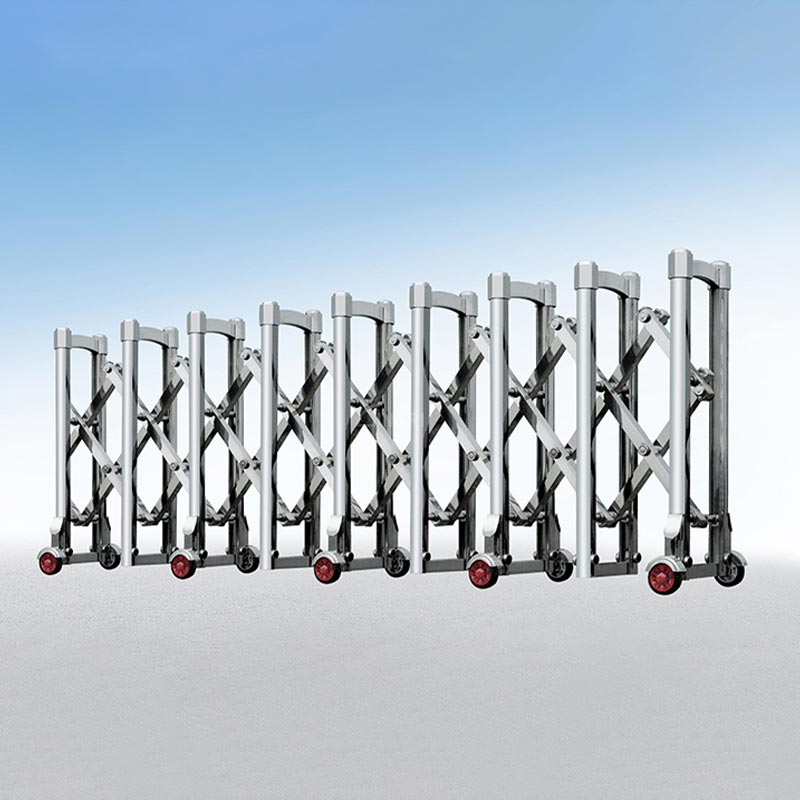
The accordion panels extend from the retracted stack when pushed from one end. No tools, no clips to fasten before use. One person can set a full unit in under two minutes once the position is chosen. The deployed width is adjustable within the range — you don’t have to go to the maximum.
Link units end to end with stainless steel connection hooks
The hooks engage at the ends of adjacent units with no tools. The join is rigid enough that the linked run holds its line under crowd pressure. There’s no visible gap at the junctions. Units can be added or removed from the run without disassembling what’s already in place.
Brake wheels — roll free, lock instantly
Heavy-duty swivel casters let a single operator maneuver a unit across hard surfaces. Foot-operated brake lock drops in a second and stays locked under load. The unit doesn’t drift.
Retracts to 0.3–0.5 m width, stores standing vertically
The retracted stack is narrow enough to fit through a standard door. Units stand vertically in storage — no floor stacking required, no special racking.
Aluminum or stainless steel
Weight difference is about 40 percent at the same cross-section. For an operator repositioning units multiple times a day across a multi-day event, that matters. For a semi-permanent installation where repositioning is infrequent, it matters less, and stainless steel’s surface durability becomes the more relevant variable.
No power, no installation, no permits
The system is self-supporting. No anchoring, no electrical connection, no ground fixings. It can be deployed in a location where permanent installation isn’t permitted and removed the same day.
Where These Get Used
Public events are the dominant application — concerts, marathons, outdoor markets, festival queue management. The equipment that defines the pedestrian corridor on day one needs to be in a different configuration on day two when the program changes. Retractable barricades handle that in minutes; panel fencing handles it with a crew and a truck.
Construction and industrial sites use them for hazard exclusion zones that move. An active work area shifts as the project progresses; the exclusion boundary needs to shift with it. A permanent fence doesn’t do that, and a temporary fence panel system takes time to reconfigure. A barricade on brake wheels rolls when the boundary moves and locks when it doesn’t.
Commercial and institutional settings — airports, shopping centers, hospitals, government buildings — keep a standing stock for queue management, temporary access control at entry points, and pedestrian routing during maintenance. The value is in the speed: two staff members pulling units from a utility room and linking them across a building entrance is a ten-minute operation, not a call to a contractor.
Schools and stadiums use them for event days — controlling flow at gates, separating ticket categories, keeping foot traffic off fields or courts during setup and breakdown. The same stock of barricades covers different event configurations because the deployed width per unit adjusts and the units link in any sequence.
The common thread across all of these is that the barrier needs to be somewhere specific today and possibly somewhere different tomorrow, and the people deploying it aren’t a specialist crew.
Aluminum or stainless steel — The Practical Difference
Both materials use the same folding mechanism and connection hardware, so the performance of the barricade as a barrier is identical. What changes is weight, surface properties, and the environments each handles better.
Aluminum — the 6063-T5 alloy — runs about 40 percent lighter than stainless steel at the same structural cross-section. On a barricade that gets repositioned several times a day by venue staff or event crew, lighter is a real operational advantage. The operator pushing the unit across a concert floor at midnight after the show ends isn’t going to appreciate the extra kilos. Aluminum doesn’t rust, so outdoor deployments in wet or coastal conditions don’t damage the frame. The standard finish is clear anodize or powder coat; either holds up well under normal event conditions.
Stainless steel makes more sense when the barricade is going somewhere it will stay for an extended period, or somewhere that gets regularly hosed down or cleaned with industrial chemicals. Food courts, healthcare corridors, processing facilities — environments where the surface takes regular chemical contact that would eventually compromise a painted or anodized aluminum finish. The brushed stainless surface also handles scuff marks differently: light surface marks from contact don’t show on brushed stainless the way they can on a powder-coated surface after a few hundred deployment cycles.
Where it gets misspecified is when buyers default to stainless because it sounds more durable, without a clear reason from the operating environment. If the barricade is going into a dry indoor venue for weekly event use, the aluminum version does the same job at lower unit weight and typically lower cost. The right choice depends on what the equipment is actually being exposed to.
Product Specifications
Technical Item
|
Specifications & Details
|
| Product Type |
Manual Retractable Barricade (Accordion Folding Crowd Control Barrier) |
| Frame Material |
6063-T5 Aluminum Alloy or 304 Stainless Steel (both available) |
| Surface Finish |
Clear anodize or powder coating (aluminum); polished finish (stainless steel) |
| Deployed Width Per Unit |
2.0 m to 10.0 m (adjustable within range; custom maximum widths available) |
| Retracted Width |
Approximately 0.3 m to 2 m depending on panel count |
| Unit Height |
1.0 m to 2.0 m (customizable to application requirement) |
| Mobility System |
Heavy-duty swivel casters with foot-operated brake lock |
| Connection Method |
Stainless steel end-locking hooks — link unlimited units end to end with no tools |
| Operation |
Manual push-pull; no power supply required |
| Load Capacity |
Rated for crowd pressure and repeated daily repositioning in public venue conditions |
| Storage Footprint |
Each unit retracts to approx. 0.3–0.5 m width; units stand vertically for compact storage |
| Application |
Public events, concerts, stadiums, construction sites, airports, shopping centers, schools, parking structures, industrial facilities |
| Customization |
Unit height, deployed width, frame material, surface finish, color (RAL for powder-coated aluminum), wheel type, connection hardware quantity |
Logistics, Storage, and Long-Term Cost
The storage question comes up early on large event and facility management orders, and the answer is better than most buyers expect going in.
Ten units, each covering up to 10 meters when deployed, represent a 100-meter perimeter capability. In storage, those ten units retract to stacks roughly 0.4 meters wide each and stand vertically. That’s about 4 meters of linear wall space — a row of units leaning against a storage room wall, not a warehouse bay. A stock that can barrier off a full building entrance or a concert perimeter fits in the kind of space a facility already has.
The long-term cost picture is simpler than with panel fencing systems. There are no electronics to fail, no hydraulics to service, no consumable components under normal operating conditions. The folding mechanism is mechanical — linked panels on pivot pins. What wears over time are the caster wheels and the brake pads, both of which are replaceable without replacing the unit. A unit that has its wheels changed every few years will still be running the same accordion structure a decade after purchase.
Plastic barriers don’t have that service life. They chalk, crack, and eventually break under repeated UV and physical contact. Each replacement cycle is a repurchase. Metal retractable barricades depreciate slowly and the maintenance cost is predictable: wheel replacement and occasional cleaning, not unit replacement.
For bulk orders — typically ten units and above — volume pricing applies. Event companies and venue operators running multiple simultaneous deployments often order in sets of twenty or thirty units, which is still a manageable storage footprint at 8 to 12 meters of wall space standing vertically.
Unit height, deployed width, frame material, and quantity are enough to generate a quote. One working day for pricing and lead time.