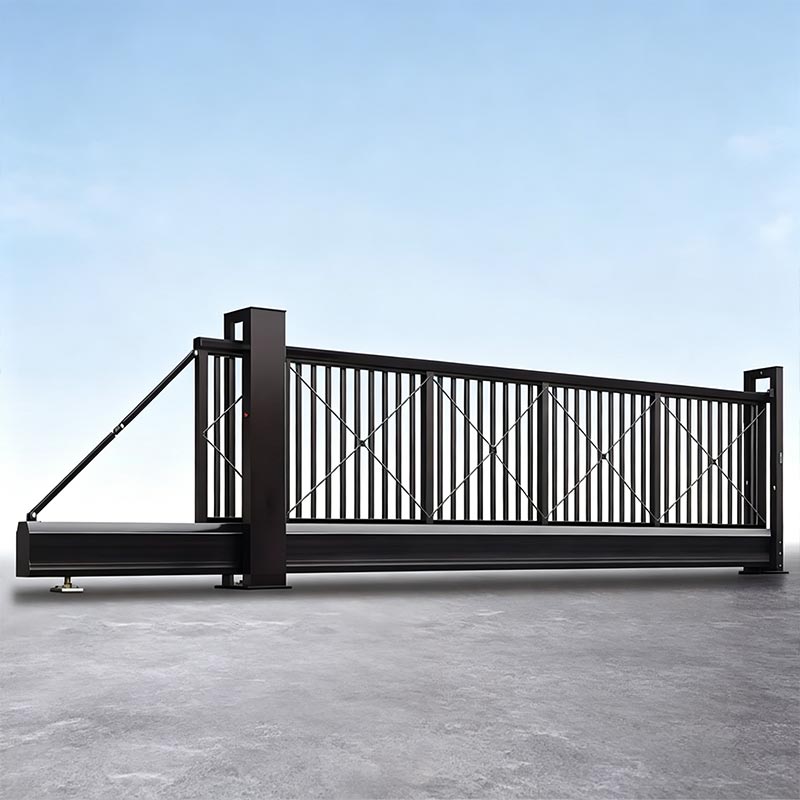
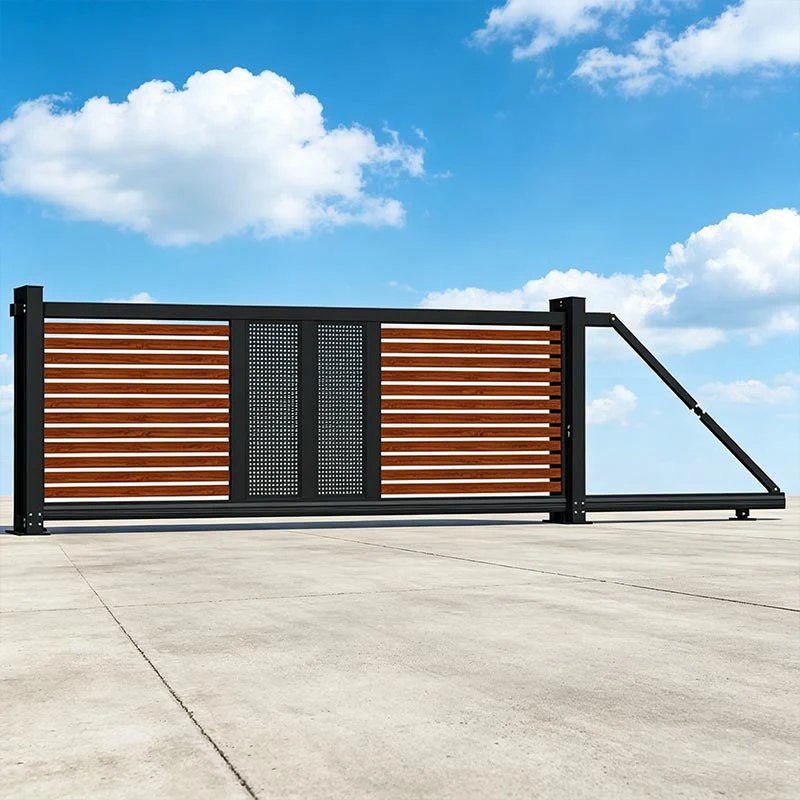
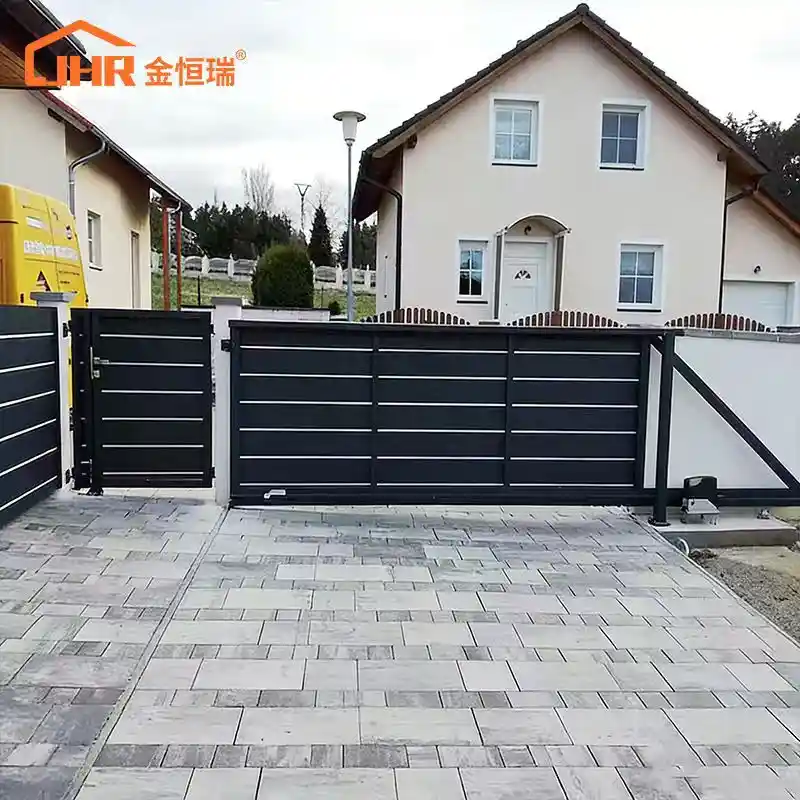
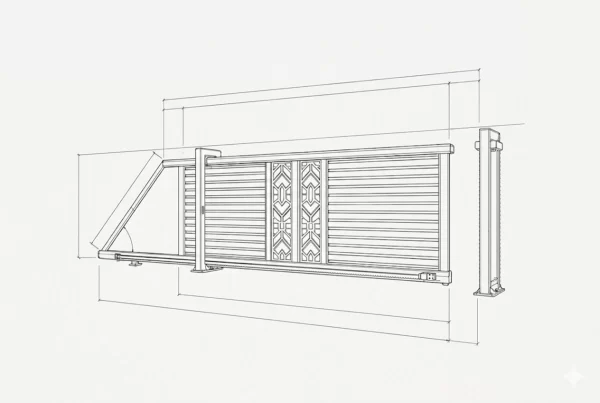
Clear span up to 16 meters, no center post
The cantilever carriage takes all the gate weight from one side. Trucks, forklifts, wide agricultural equipment — nothing in the opening to navigate around. For spans above 16 meters, the engineering team reviews on a case-by-case basis.
Ground track eliminated
No channel to fill with site debris, no rail surface to crack under repeated heavy vehicle crossings, no seasonal heave from frost or ground movement to throw the alignment. The carriage overhead is what carries the gate; the ground just has to be level enough for vehicles.
Internal or external motor — same gate, different mounting
External: bracket-mounted outside the post, accessible for inspection and service without opening anything. Internal: drive unit sealed inside the post housing, protected from dust ingress and physical contact. The choice is usually a site access question, not a performance one.
Remote, RFID, loop, BMS — all available for choice
RF handsets, proximity card readers, keypad units, inductive loop detectors for automated vehicle sensing, RS485 and dry contact outputs for building management integration. The control interface is specified at order; the gate frame accommodates all of them.
6063-T5 aluminum alloy frame
Higher grade than the 6063-T5 used in residential product lines — the T5 temper adds tensile strength suited to large-span industrial loading. The surface doesn’t rust; epoxy-primer under the powder topcoat handles the UV and particulate exposure on industrial sites.
High-frequency duty cycle rated
Engineered for the cycle volumes that factory and logistics entrance gates actually run — not rated for residential use and then deployed industrially.
Steel vs Aluminum on a Large-Span Cantilever Gate
The instinct toward steel on industrial gates is understandable. Steel is what most people have seen on existing factory sites, and heavy-duty and steel have become associated terms in procurement conversations. The issue is that the weight of a steel cantilever frame at 12 to 16 meters is a significant number, and that weight is what determines the size of every other component in the system.
At a 14-meter span, the carriage bearings are supporting that dead load on every cycle — not just when the gate is moving, but continuously when it’s sitting stationary at full extension. The rollers wear at a rate proportional to the load they’re carrying. Motor peak current on each open-close cycle scales with the inertia of the frame. As the steel surface weathers — rust at the weld points, debris compaction in the carriage channel, coating degradation at the bottom rail — rolling resistance increases, and the motor is working harder against a frame that’s also getting heavier in effective terms as rust and remediation layers accumulate.
The 6063-T5 aluminum frame changes the starting number. At 35 to 40 percent of the steel weight across the same span, the carriage bearing load drops proportionally from day one. The motor operates within a more comfortable margin of its rated capacity on every cycle. The frame doesn’t rust, so rolling resistance doesn’t increase as the gate ages the way it does on a steel installation. JHR has industrial cantilever gates that have been running for over a decade on the original motor and carriage hardware — on steel installations of comparable span and cycle frequency, the service history rarely looks the same.
The powder coating specification on JHR industrial gates uses an epoxy-polyester primer under the topcoat. That primer layer is not standard on residential-grade gate coatings; it’s there because industrial sites have higher UV intensity, more airborne particulates, and greater thermal cycling than residential environments. Color durability on the epoxy-primer system holds measurably longer than standard architectural powder in those conditions.
Motor Configuration: External vs Internal
Most industrial sites go with the external motor mount. It’s straightforward to understand why: when something needs adjustment or replacement, the drive unit is sitting on a bracket in plain sight. Belt tension, limit switch position, chain wear — a technician can check all of it without opening a post housing. On sites where the maintenance team handles gate servicing themselves, that accessibility matters more than how the installation looks.
Internal mounting makes sense on a different set of sites. If the gate post is in a vehicle traffic zone — a logistics yard where forklift contact with site hardware is a realistic risk — putting the motor inside a sealed housing reduces the exposure. Government facilities and institutional installations sometimes require the clean architectural profile that internal mounting provides. The access panels on the post face are designed for maintenance without full post disassembly; the service interval is just longer between access events.
The control interface is the same either way. RF remote handsets for personnel on foot. RFID proximity readers where card-controlled access is the security protocol. Keypad units for PIN-based entry. Inductive loop detectors buried in the approach surface for automated vehicle sensing without human intervention. RS485 or dry contact outputs for sites running building management systems that need to log gate events or integrate with wider access control infrastructure.
Battery backup is available as an option — relevant for sites where power interruption during a security event is an operational problem, not just an inconvenience.
Product Specifications
| Technical Item |
Specifications & Details |
| Gate Type |
Industrial Heavy Duty Cantilever Sliding Gate (Trackless) |
| Material |
6063-T5 Aluminum Alloy structural profiles |
| Surface Finish |
Epoxy-primer + powder topcoat — standard or custom RAL colors |
| Maximum Clear Span |
Up to 16.0 meters standard; wider spans on engineering review |
| Gate Height |
1.5 m to 2.4 m (customizable to site requirement) |
| Motor Configuration |
External bracket mount or internal post-integrated mount (both available) |
| Drive System |
High-torque industrial sliding gate motor — 24V DC or 380V / 220V AC |
| Carriage System |
Heavy-duty overhead cantilever rollers; no ground track required |
| Control Options |
RF remote, RFID reader, keypad, loop detector, intercom, BMS integration (RS485 / dry contact) |
| Smart Compatibility |
Compatible with major smart access platforms and industrial building management systems |
| Safety Features |
Infrared photocell sensors, auto-reverse on obstacle, manual emergency release, battery backup option |
| Cycle Rating |
Rated for high-frequency industrial duty cycle operation |
| Application |
Manufacturing plants, logistics and distribution centers, government facilities, commercial perimeter security, public infrastructure access control |
| Customization |
Span width, height, motor type and position, control interface, RAL color, infill panel style, security accessories |
Installation and Site Requirements
The foundation post on the motor side is the civil works item that determines everything else. It carries the full cantilever load of the gate span — for a 14- or 16-meter gate, that’s a meaningful structural requirement. JHR provides foundation engineering specifications with every order: post cross-section, rebar layout, footing depth, and the wind load assumptions the calculation is based on. The customer supplies the local wind load data for the site; JHR runs the foundation spec from that input.
Because there’s no ground track, site preparation outside the foundation post area is minimal. A guide wheel mount goes in at the leading edge of the gate travel path to keep the panel from swaying laterally — that’s a small embedded anchor, not excavation across the driveway width. On sites where a tracked gate would require cutting a channel across an active logistics surface, the cantilever option often reduces civil works time by a day or more, which has its own cost implication.
Commissioning time for a standard JHR industrial cantilever unit runs one to two days for a team familiar with the system — span width and motor configuration are the variables. CAD drawings, hardware kits, and commissioning checklists ship with the gate. The engineering team handles remote support during motor programming and initial cycle testing; sites outside straightforward installation range don’t need to source that support separately.Span, gate height, site location, motor preference, and control interface requirements are the inputs needed to start a quote. One working day for specification sheet and pricing from the date of inquiry.