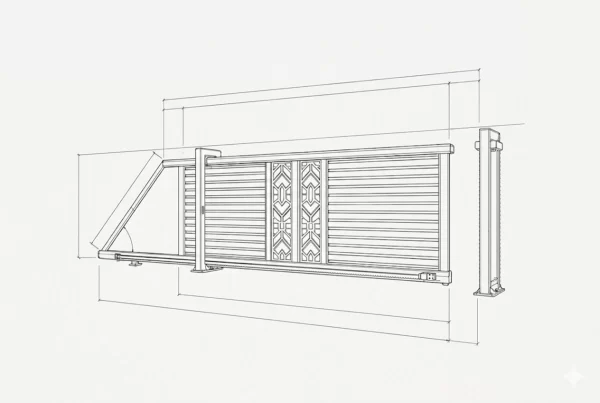
Why Trackless Cantilever Is the Right System for a Farm Entrance
The tracked sliding gate is fine on a sealed suburban driveway. The ground is stable, level, and clean — concrete or paving that stays predictable. Farm driveways are different in every relevant way: surface varies seasonally, vehicles crossing the gate threshold include tractors, trailers, livestock trucks, and wide agricultural equipment that would destroy a track rail in a few passes.
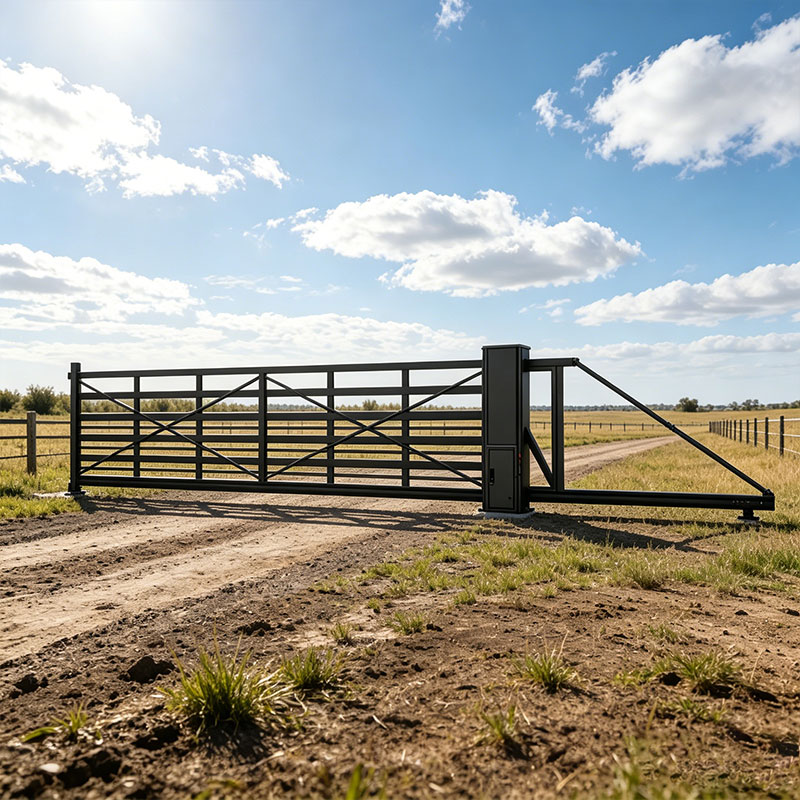
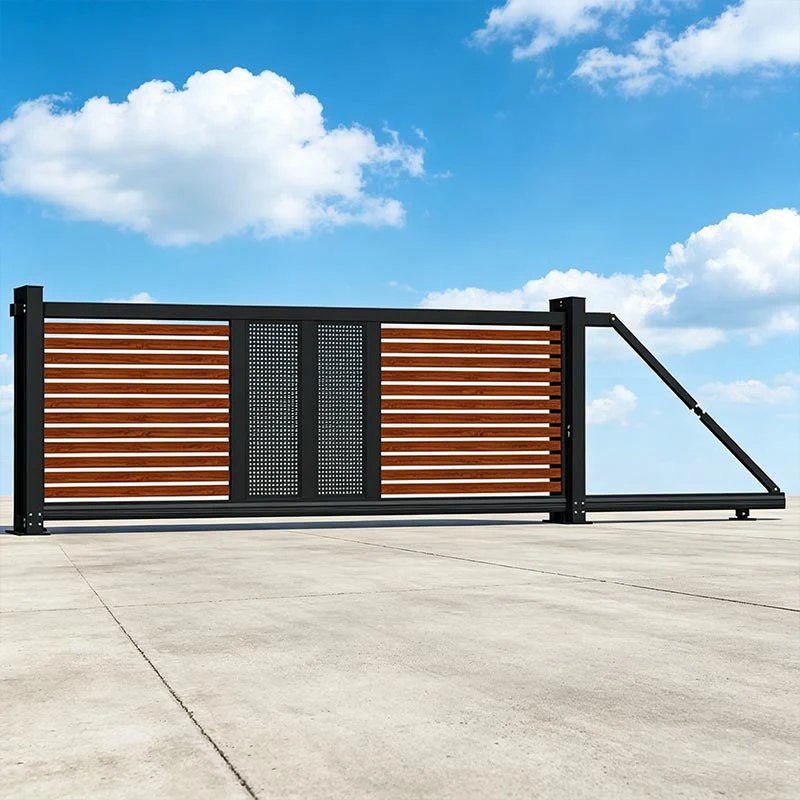
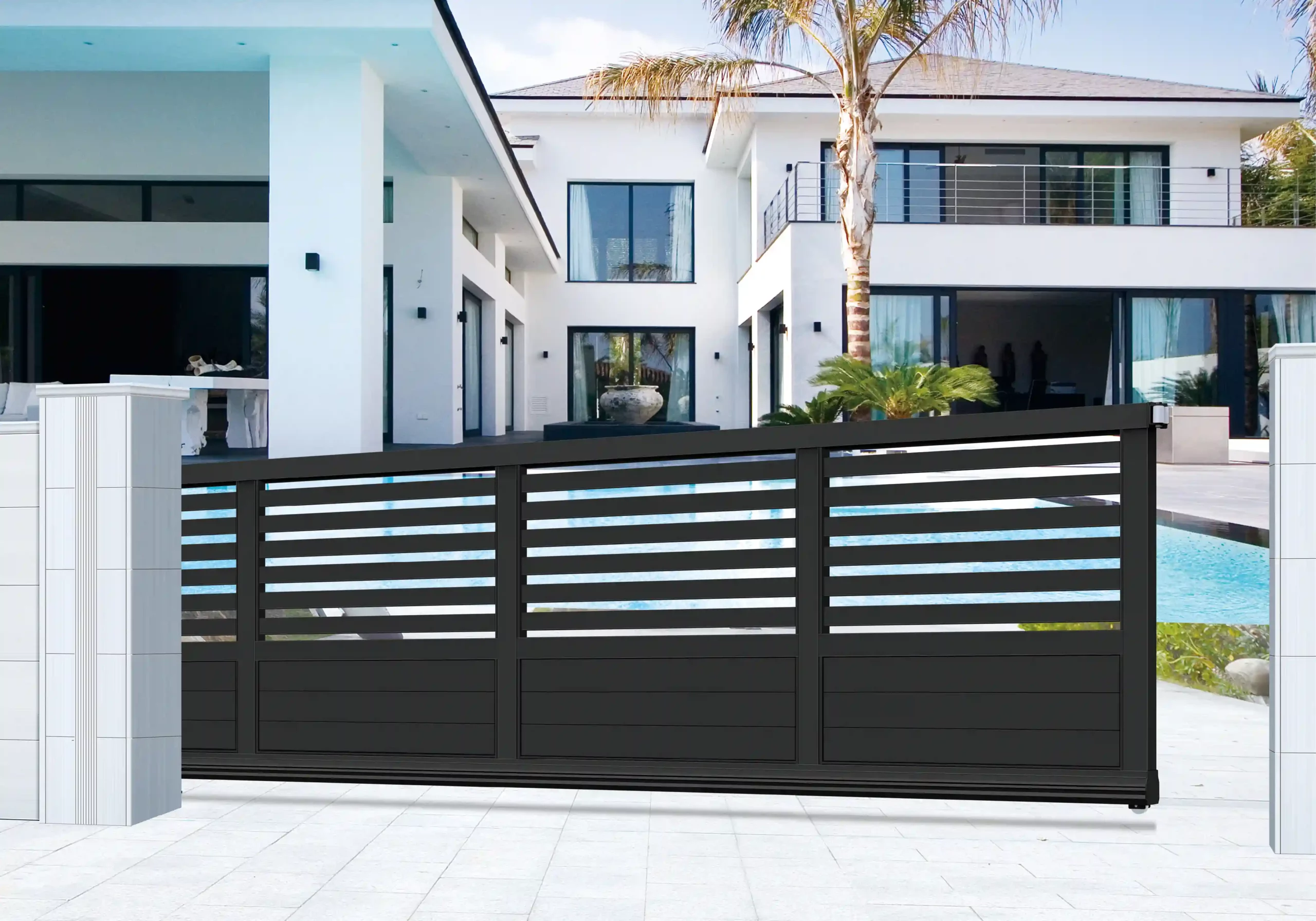
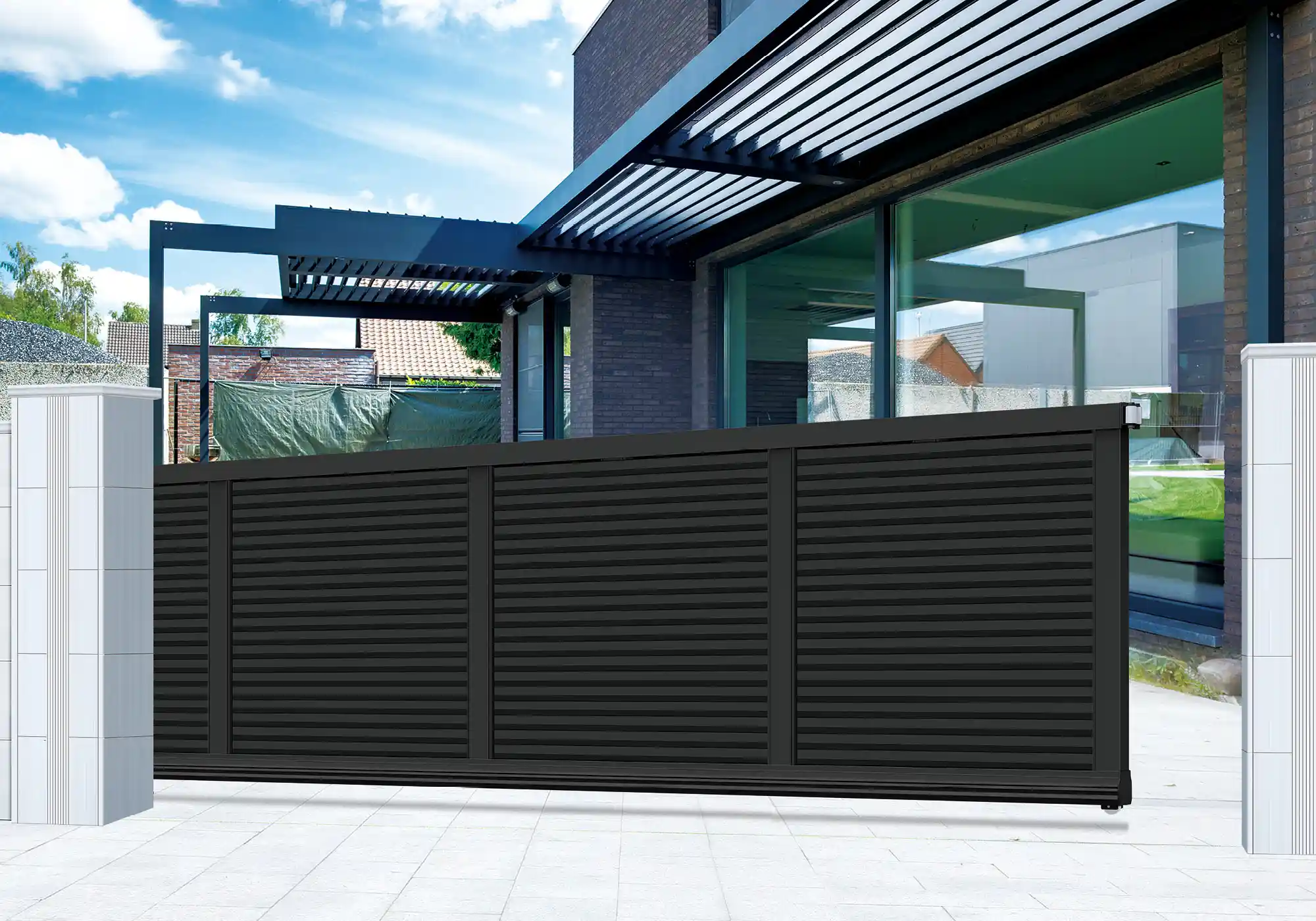
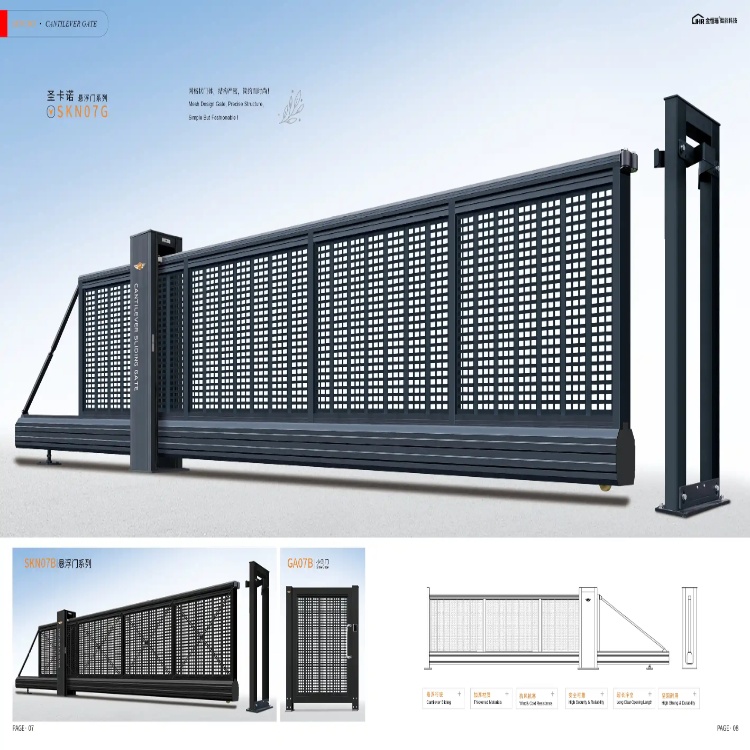
The cantilever mechanism removes the ground contact from the equation. The gate panel is suspended from an overhead carriage assembly inside a housing that sits on a single reinforced post. The rear section of the gate frame — roughly half the total gate length — extends behind the post as a counterbalance. The panel travels across the opening without any contact with the ground surface below it.
For agricultural vehicles, the trackless opening has a practical secondary benefit: there is no rail in the path of a tyre or a skid-steer bucket. Heavy machinery crossing a tracked gate threshold damages the track housing on the first crossing and progressively misaligns the gate on subsequent ones. Cantilever installations don’t have that failure mode because there’s nothing at ground level to damage.
The ground clearance of 50 to 100 mm is set during installation by adjusting the carriage roller height. For sites with significant surface variation — uneven approaches, seasonal mud buildup, grass that grows along the gate line — the clearance can be set toward the higher end without compromising livestock containment, because the gap is below the knee height of any standard farm animal.
Motor and Smart Access Options
Getting out of a tractor to open a gate manually, twice per entry, adds up fast across a working week. A single-person farm operation does that thirty or forty times a week on a busy property. Motorization with RF remote access pays for itself in operational time within the first year on most working farms — that’s not a product claim, it’s arithmetic.
The JHR cantilever farm gate is designed for motor installation from the beginning, not as an afterthought. The rack strip is pre-fitted to the gate frame at the factory. The support post includes welded mounting provisions for the motor bracket. An installer doesn’t need to drill into the gate frame or fabricate custom brackets on site.
Standard setup: high-torque sliding gate motor, 24V DC or 220V AC, with RF remote handsets at 433 MHz. Up to 50 remotes registered per controller on standard motor units — enough for the farm vehicle fleet plus the house, without needing to buy a commercial controller. The gate opens, the vehicle passes through, and the gate closes on a timer. No manual intervention.
For properties with more complex access requirements — farm workers, contractors, delivery drivers, agronomists — the control system can be extended without replacing the motor:
PIN keypad: individual codes per user, temporary codes for contractors with a set expiry date. Mounted weatherproof on a post at the gate approach, accessible from a vehicle window.
Fingerprint reader: outdoor-rated capacitive sensor, up to 100 enrolled prints, recognition under 0.5 seconds. Works on dirty or gloved hands on current-generation sensors — relevant on a working farm.
RFID card and fob reader: proximity access, 125 kHz or 13.56 MHz format. Cards issued and revoked remotely without a site visit; suitable for farm staff and regular delivery accounts.
Smartphone app: Bluetooth proximity unlock for approach access, or GSM-connected module for remote operation and live gate status monitoring from anywhere with mobile coverage.
All configurations include a manual release on the motor unit — the gate can be pushed open by hand during a power outage. Battery backup units are available for sites where mains power is unreliable or the gate is on a rural circuit with intermittent supply.
Technical Item
|
Specifications & Details
|
| Product Type |
Aluminum Cantilever Sliding Farm Gate — trackless, ground-clear design |
| Frame Material |
6061-T6 Aluminum Alloy — main frame rails, cross-bracing, and top/bottom chords |
| Surface Finish |
Chromate primer + outdoor powder topcoat — standard or custom RAL colors |
| Gate Width (Clear Span) |
3.0 m to 12.0 m standard; wider spans on engineering review |
| Gate Height |
1.2 m to 2.4 m (customizable to site and livestock containment requirement) |
| Ground Clearance |
50 mm to 100 mm (adjustable at carriage roller height during installation) |
| Cantilever Ratio |
Gate panel approx. 150% of clear span; rear counterbalance approx. 50% |
| Carriage System |
Heavy-duty overhead cantilever rollers with sealed bearings; no ground track required |
| Motor Compatibility |
All major sliding gate motor brands; rack strip pre-fitted to gate frame |
| Drive System |
Rack and pinion; 24V DC or 220V AC motor options |
| Access Control Options |
RF remote (433 MHz), PIN keypad, fingerprint reader, RFID card/fob (125 kHz / 13.56 MHz), smartphone app (Bluetooth / GSM) |
| Safety Features |
Infrared photocell sensors, auto-reverse on obstacle, manual release for power failure, battery backup option |
| Wind and Impact Resistance |
Diagonal cross-brace panel design; frame rated for rural wind load conditions |
| Application |
Farm driveways, rural properties, agricultural facilities, livestock stations, vineyard and orchard entrances, rural residential |
| Customization |
Gate width, height, ground clearance, RAL color, motor brand, access control type, battery backup, post configuration |
Installation and Site Requirements
The foundation for the cantilever post is the one civil works item that determines everything else. It carries the full cantilever load of the gate span — for a 10- or 12-meter gate, that’s a significant structural requirement. JHR calculates the foundation dimensions, rebar layout, and concrete volume from the gate span and the local wind load data for the site, and supplies that specification with every order. The installer doesn’t need to derive it.
No ground track excavation is required. That’s typically the most time-consuming civil works item on a tracked gate installation of the same span — cutting across the driveway surface, laying the track housing in concrete, waiting for it to cure before the gate can be installed. On a cantilever installation, the civil works is one post hole.
The gate panel is lifted into the carriage after the post is set and cured. Counterbalance is adjusted until the panel sits level across the full travel path. The motor mounts to the post bracket, the rack engages the pinion, and the limit switches are set. An experienced two-person team typically completes a standard 6- to 8-meter farm gate with motor within one working day.
Maintenance after commissioning: check and lubricate the carriage roller bearings annually with waterproof outdoor grease. The aluminum frame needs nothing. The motor follows the manufacturer’s service schedule — typically checking limit switches and the motor clutch once a year. JHR supplies installation drawings, a hardware kit, and remote support with every order.
Clear span, gate height, site location, motor preference, and access control requirements are enough to start a quote. One working day for specification and pricing.