Why the Counterbalanced Pivot Works
The physics of a conventional side-hung gate are straightforward and unfavorable for wide spans. The upper hinge is carrying close to the full panel weight as a shear load — the panel hangs from it like a sign from a bracket. That shear load on the hinge bolt translates into a bending moment on the gate post at the hinge mounting height, and that bending moment is what requires the post footing to resist it.
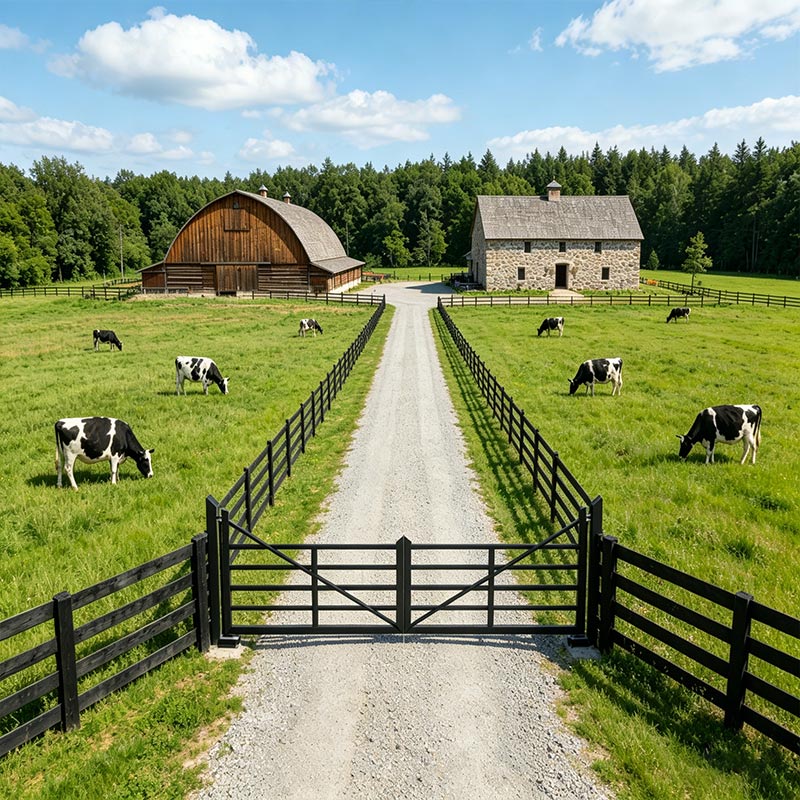
On a farm gate, “wide span” means the problem is worse, and “farm site foundation” means the footing is working in more variable conditions than a residential installation. Most farm gate post failures trace back to the combination of these two factors: more load, less stable footing.
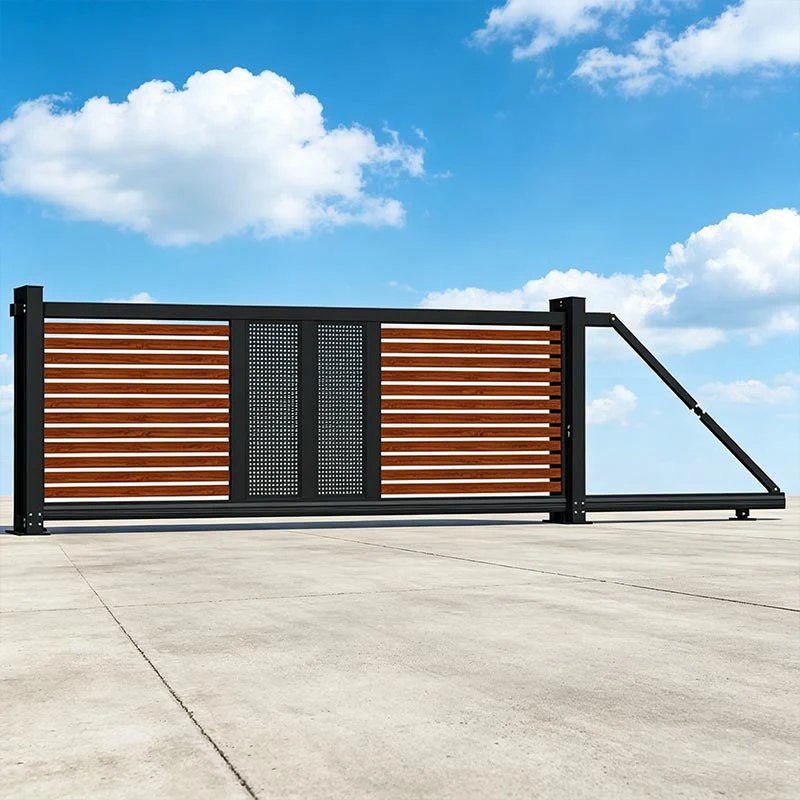
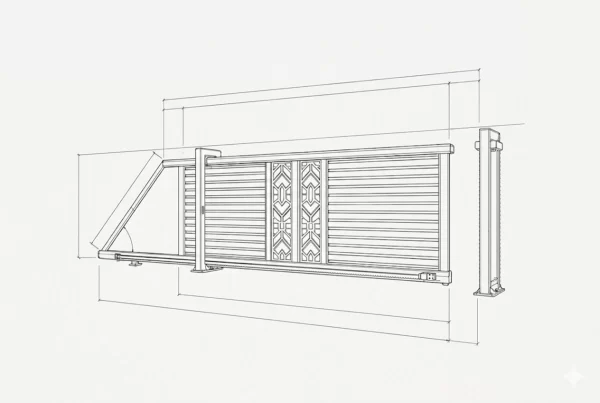
The counterbalanced pivot changes the load path. The pivot arm is balanced around the post — some panel weight in front, some counterbalance behind. The net force on the pivot bearing is the difference between the two, not the full panel weight. That net force acts vertically downward through the pivot, compressing the post rather than bending it. Compressive loads are what posts and footings handle well; bending moments are what they handle poorly over time.
On a farm site where the gate cycles many times daily as vehicles and livestock pass through, the reduced bearing load is also a service life argument: fewer cycles at lower load on the pivot hardware means longer intervals before adjustment or replacement. The gate also opens more freely with less initial force — relevant when operating from inside a tractor cab at the end of a long day, and doubly relevant if the gate is motorized and the actuator is sized to the actual load rather than the full panel weight.
Motor and Smart Access for Rural Operation
The sequence of manually operating a farm gate from a vehicle goes: stop, engage handbrake, get out, open gate, get back in, drive through, stop again, get out again, close gate, latch it, get back in. On a busy property with multiple gate crossings per day, that adds up to a meaningful slice of productive time. Motorization removes all of it except driving through.
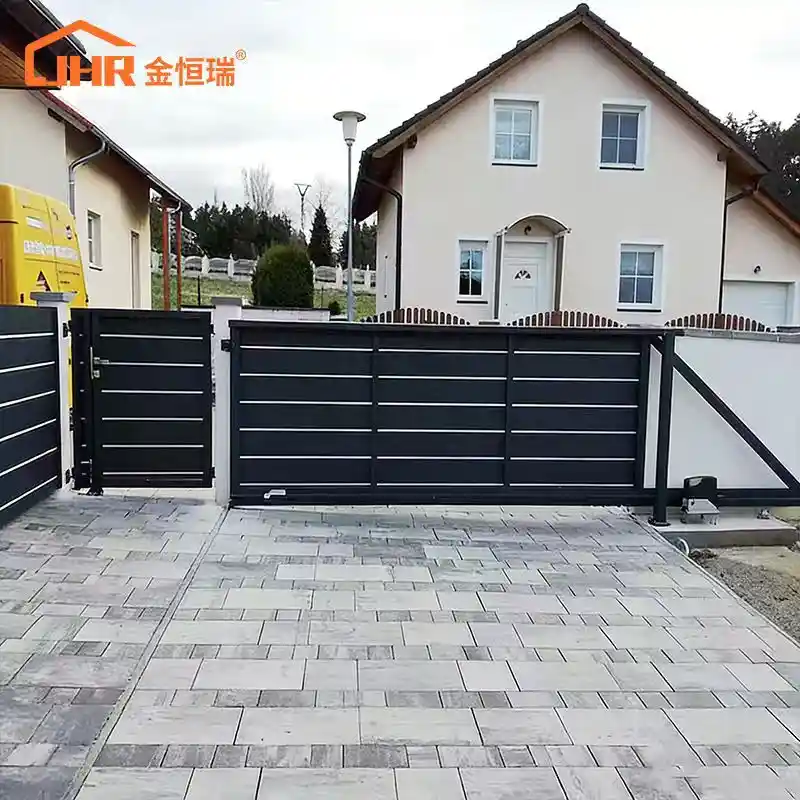
The JHR cantilever swing gate is prepared for motor installation from the factory. The pivot arm includes mounting positions for the motor bracket, and the gate panel has a reinforced attachment point for the actuator clevis. An installer doesn’t fabricate custom brackets on site — the mounting geometry is already there.
Standard setup: linear actuator or articulated arm swing gate motor, 24V DC, with RF remote handsets at 433 MHz. The gate opens on the remote press, the vehicle drives through, and the gate closes on a timer. Up to 50 remotes can be registered on a standard motor controller — enough for the full farm vehicle fleet without upgrading to a commercial controller.
For properties where access control involves more than one category of user:
- PIN keypad: Post-mounted, multiple individual codes per unit, temporary contractor codes with automatic expiry. The expiry function is the practically important part — a contractor who finished the job last week doesn’t need access next week, and with expiring codes you don’t have to track who has what code and revoke them manually.
- Fingerprint reader: Outdoor-rated sensor, up to 100 enrolled prints, recognition under 0.5 seconds. No card to lose, no code to share. On a property where farm staff change seasonally, adding and removing fingerprints from the administrator panel is faster than tracking physical keys or cards.
- RFID card and fob reader: 125 kHz or 13.56 MHz proximity format. Cards issued and revoked remotely without visiting the gate. Useful for regular delivery accounts and veterinary practices that need regular access — they get a fob rather than a code or a physical key, and if the relationship ends, the fob is revoked immediately.
- Smartphone app: Bluetooth proximity unlock for approaching on foot or from a vehicle. GSM module option adds remote operation from anywhere with mobile coverage — useful for a farm owner who needs to let in a contractor while they’re in a different paddock on the property.
All configurations include a mechanical manual release on the motor and a key-operated latch as backup for power outage conditions. Battery backup units are available for sites where mains supply is intermittent or unreliable.
Technical Item
|
Specifications & Details
|
| Product Type |
Aluminum Cantilever Swing Farm Gate — single-leaf, counterbalanced pivot |
| Frame Material |
6063-T5 Aluminum Alloy — panel rails, cross-bracing, pivot arm, and counterbalance frame |
| Surface Finish |
Chromate primer + outdoor powder topcoat — standard or custom RAL colors |
| Panel Width |
2.0 m to 6.0 m (customizable; wider panels on engineering review) |
| Panel Height |
1.2 m to 2.4 m (customizable to site and livestock containment requirement) |
| Pivot System |
Heavy-duty cantilever pivot bearing; counterbalance arm reduces net post load |
| Counterbalance |
Structural rear arm with adjustable counterweight — factory set to panel weight |
| Motor Compatibility |
All major linear actuator and articulated arm swing gate motor brands |
| Drive System |
Linear actuator (24V DC) or articulated arm (24V DC / 220V AC) |
| Access Control Options |
RF remote (433 MHz), PIN keypad, fingerprint reader, RFID (125 kHz / 13.56 MHz), smartphone app (Bluetooth / GSM) |
| Safety Features |
Infrared photocell sensors, auto-reverse on obstacle, manual release, battery backup option |
| Panel Structure |
Horizontal rails with diagonal cross-brace pattern — wind load and livestock impact rated |
| UV & Weather Resistance |
Powder coat rated 15+ years color and adhesion stability under direct UV, rain, and salt-air exposure |
| Application |
Farm driveways, rural properties, agricultural facilities, livestock stations, equestrian properties, rural residential |
| Customization |
Panel width, height, RAL color, pivot arm configuration, counterbalance adjustment, motor brand, access control type, battery backup |
Installation and Site Requirements
One post, one foundation. That’s the civil works scope — a single reinforced concrete footing for the pivot post, positioned at one side of the driveway opening. JHR provides the footing dimensions and rebar specification calculated from the panel width, panel weight, and local wind load data with every order. Because the counterbalance arm reduces the net bending load on the post, the footing spec is typically smaller than what a conventional hinged gate of the same width would require on the same site.
The installation sequence: set the pivot post and let the concrete cure. Mount the pivot bearing assembly at the correct height on the post. Attach the gate panel to the pivot arm and adjust the counterbalance arm to the panel weight — the counterbalance is factory-set but has field adjustment for fine-tuning after installation. Fit the motor actuator between the post bracket and the gate panel attachment point. Install photocell sensors at the gate line. Run motor wiring to the control box on the post, with cable runs to any remote readers or loop detectors at the approach.
A two-person experienced installation team typically completes a standard 4-meter swing gate with motor and RF remote within one working day. Add two to four hours for smart access additions — keypad, fingerprint reader, or GSM module — for wiring and initial programming. JHR supplies installation drawings, a hardware kit, and remote technical support for all installations.
One practical note on site assessment before installation: the swing arc of the gate needs to be clear for the full travel range. On a farm where the ground surface changes seasonally, check the arc in the worst-case surface condition — if the gate swings over an area that accumulates mud or produces ruts, the bottom rail clearance needs to be set to account for it at installation rather than discovered six months later.
Panel width, gate height, site location, preferred motor type, and access control requirements are enough to start a quote. One working day for specification and pricing.
Item
|
Recommendation
|
| H1 Tag |
Aluminum Cantilever Swing Farm Gate |
| H2 Tags |
Product Overview / Why the Counterbalanced Pivot Works / Motor and Smart Access for Rural Operation / Product Specifications / Installation and Site Requirements |
| Image Alt Tag |
JHR Aluminum Cantilever Swing Farm Gate — Rust-Free Rural Driveway Gate with Motor and Smart Access |
| Internal Links |
Link “cantilever swing farm gate” to farm gate category; “aluminum alloy” to materials overview; “swing gate motor” to automation accessories; “cantilever sliding farm gate” to sliding variant product page; “smart access” to access control accessories |
| Schema Markup |
Add Product schema (brand, material, color, panel width range, access control options, application) for Google Rich Results eligibility |
| Content Cluster |
Blog posts: “cantilever swing gate vs hinged swing gate: which handles wide farm openings better” / “how to automate a farm swing gate: actuator, remote, and smart access options” / “aluminum vs steel farm gates: 10-year cost and maintenance comparison” |